HVAC Door Hanger Distribution | Direct to Door Marketing

HomeDoor Hanger DistributionHVAC Door Hanger Distribution

HVAC Door Hanger Distribution: The Complete Guide to Generating Heating & Cooling Leads with Door Hangers

The definitive resource for HVAC contractors, heating and cooling companies, and home comfort service providers who want to generate more service calls, maintenance agreements, and system installation leads through targeted door hanger marketing. Powered by Direct to Door Marketing — America’s largest distribution network with 32,267+ professional distributors and AI-verified Proof of Delivery.

Get Your Free HVAC Campaign Quote Call (866) 643-4037
Since 1995 — 30+ Years 32,267+ Distributors 500M+ Pieces Distributed 99% U.S. Zip Coverage AI Platform — Proof of Delivery
CarrierTraneLennoxRheemGoodmanDaikinYorkBryantAmerican StandardAmanaRuudHeilColemanMaytagFrigidaireMitsubishi ElectricFujitsuBoschLGSamsung CarrierTraneLennoxRheemGoodmanDaikinYorkBryantAmerican StandardAmanaRuudHeilColemanMaytagFrigidaireMitsubishi ElectricFujitsuBoschLGSamsung

What Is HVAC Door Hanger Marketing?

HVAC door hanger marketing is a targeted advertising strategy where heating, ventilation, and air conditioning companies distribute promotional door hangers directly to residential homes in specific neighborhoods and service areas. Unlike broadcast advertising that reaches everyone regardless of need, HVAC door hangers deliver your message to the exact homeowners most likely to need your services — targeting neighborhoods with older homes, aging HVAC systems, upcoming seasonal maintenance needs, or areas affected by extreme weather events.

The HVAC industry is uniquely suited to door hanger marketing because heating and cooling services are universally needed by homeowners, inherently local in nature, seasonally driven, and often triggered by urgent circumstances where the first company a homeowner thinks of gets the call. Door hangers placed directly on residential front doors create a physical brand impression that digital advertising cannot replicate — and when the AC breaks down on a 100-degree day or the furnace fails during a winter storm, the HVAC company whose door hanger is on the homeowner’s refrigerator gets the emergency call.

Direct to Door Marketing has been distributing door hangers for HVAC contractors and heating and cooling companies since our founding in 1995. With 32,267+ professional distributors, 99% U.S. zip code coverage, and our proprietary AI Management Platform with Proof of Delivery photos, we provide the largest, most accountable HVAC door hanger distribution service in America. From single-location contractors to multi-state franchise operations, our network delivers your HVAC marketing materials to the exact neighborhoods where homeowners need your services most.

Why Door Hangers Are the Perfect Marketing Tool for HVAC Companies

The HVAC industry has unique characteristics that make door hanger marketing exceptionally effective compared to other advertising channels. Understanding these advantages helps HVAC business owners appreciate why the nation’s most successful heating and cooling companies invest heavily in targeted door hanger distribution.

Universal Homeowner Need

Every homeowner with an HVAC system is a potential customer — and in the United States, that means virtually every residential property. Unlike niche services that appeal to a small percentage of homeowners, HVAC maintenance, repair, and replacement are inevitable needs for every household. Door hangers distributed to any residential neighborhood reach an audience where 100% of recipients will eventually need your services. No other marketing channel reaches this kind of universally relevant audience with guaranteed physical delivery to their front door.

Seasonal Demand Predictability

HVAC demand follows highly predictable seasonal patterns that door hanger campaigns can target with precision. Spring brings AC tune-up season. Summer triggers emergency cooling calls. Fall drives furnace preparation. Winter generates emergency heating demands. This seasonality allows HVAC companies to distribute door hangers weeks before anticipated demand peaks, positioning their brand as the first-call solution when homeowners begin experiencing seasonal needs. No other home service category has such predictable, recurring demand cycles that align perfectly with strategic door hanger distribution timing.

Emergency Service First-Call Advantage

When an HVAC system fails during extreme weather, homeowners need help immediately. They do not methodically research contractors online — they call the first company they think of. A door hanger on the refrigerator, kitchen counter, or bulletin board provides instant access to a company name and phone number during an emergency. This first-call advantage is enormously valuable because emergency service calls typically generate the highest revenue per visit and often lead to system replacement sales. Door hangers create the physical brand presence that captures these high-value emergency calls.

High Customer Lifetime Value

HVAC customers represent exceptional lifetime value — estimated at $10,000-$15,000+ per household over the relationship lifecycle including seasonal maintenance plans ($150-300/year), repair services ($200-1,500+ per call), and eventual system replacement ($5,000-$15,000+). This extraordinary lifetime value means that even modest customer acquisition rates from door hanger campaigns generate substantial return on investment. A single new maintenance agreement customer acquired through a door hanger can generate thousands of dollars in revenue over their lifetime — many times the cost of the entire distribution campaign that acquired them.

Tangibility Creates Trust

Homeowners inherently trust HVAC companies that invest in professional, physical marketing materials. A well-designed door hanger on quality cardstock signals that your company is established, professional, and committed to the community. In an industry plagued by fly-by-night operators and online scams, physical marketing creates a trust signal that digital advertising cannot replicate. Homeowners save professional-looking HVAC door hangers because they know they will need heating and cooling service eventually — and they want a company that appears legitimate, established, and reliable when that need arises.

Neighborhood Domination Potential

HVAC companies that distribute door hangers consistently to the same neighborhoods build a dominant local brand presence that competitors cannot easily challenge. When every homeowner in a subdivision has received your door hanger multiple times, your company becomes the default HVAC provider for that area. Neighbors recommend you to neighbors. Homeowners who see your trucks in the neighborhood connect them with the door hangers they have received. This neighborhood saturation effect is uniquely powerful for HVAC companies because word-of-mouth referrals are the primary driver of new customer acquisition in the heating and cooling industry.

HVAC Door Hanger Marketing Calendar: Month-by-Month Strategy

Timing is everything in HVAC marketing. Distributing door hangers at precisely the right moment — weeks before seasonal demand peaks, during extreme weather events, or just before maintenance seasons begin — dramatically increases response rates and lead quality. This month-by-month calendar provides a strategic framework for year-round HVAC door hanger campaigns that capture demand at every seasonal touchpoint.

January-February: Winter Emergency & IAQ

Mid-winter is prime territory for emergency heating service campaigns and indoor air quality promotions. Furnace breakdowns peak during the coldest months, making emergency service awareness critical. Door hangers should emphasize 24/7 emergency heating repair availability, indoor air quality assessments (homeowners spend the most time indoors during winter), humidifier installations, and maintenance agreement enrollment for the coming year. Target neighborhoods with homes built before 2000 where furnace systems are approaching or past their expected lifespan. Rapid-deployment campaigns during cold snaps generate the highest-urgency response of any HVAC marketing timing.

March-April: Spring AC Tune-Up Season

The spring AC tune-up window is the single most important door hanger distribution opportunity of the year for HVAC companies. Homeowners are motivated to prepare their cooling systems before summer heat arrives. Door hangers should promote seasonal AC tune-up specials, early-bird pricing for system inspections, and maintenance agreement sign-ups. Distribute in early-to-mid March to capture demand before competitors flood the market with spring promotions. This is also an excellent time for new customer acquisition campaigns — offering first-time service discounts to homeowners who are not currently using a regular HVAC provider.

May-June: Pre-Summer & System Replacement

As temperatures climb, homeowners who skipped spring tune-ups begin experiencing AC issues. Door hangers during this window should emphasize system evaluation and replacement financing options for homeowners with aging equipment. Target neighborhoods with homes built in the 1990s and early 2000s where original AC systems are reaching end-of-life. Energy efficiency messaging resonates strongly as utility bills begin rising — new high-efficiency systems that reduce monthly energy costs by significant percentages create compelling value propositions. Include financing options prominently — many homeowners delay replacement due to cost concerns that flexible financing eliminates.

July-August: Emergency AC & Duct Cleaning

Peak summer heat generates the highest volume of emergency AC repair calls. Door hangers distributed during heat waves create immediate response because homeowners without functioning AC are desperate for rapid service. Emphasize same-day and 24/7 emergency service, rapid response times, and fair pricing that builds trust during a stressful situation. Duct cleaning promotions also perform well during peak summer as homeowners become aware of air quality issues when their systems run continuously. Back-to-school timing in August creates campaigns promoting healthy indoor air for students studying at home.

September-October: Fall Furnace Prep

The fall furnace tune-up season is the second most valuable door hanger distribution window after spring AC campaigns. As temperatures begin dropping, homeowners think about heating preparation — but many procrastinate until cold weather forces the issue. Door hangers distributed in September create urgency before the rush: “Schedule your furnace tune-up now before the busy season — slots fill up fast.” Promote carbon monoxide safety checks, which resonate with families concerned about winter safety. This is also peak season for smart thermostat installation campaigns, as homeowners prepare for higher heating bills and seek energy-saving solutions.

November-December: Holiday Safety & Heating

Holiday season campaigns should blend safety messaging with service promotion. Carbon monoxide detector awareness, furnace safety inspections, and emergency heating preparedness resonate with families during the holidays. Door hangers offering “peace of mind” heating inspections before family gatherings create urgency tied to home entertaining. Gift certificate campaigns for HVAC services — maintenance agreements as gifts for elderly parents or new homeowners — generate unique holiday-season revenue. Year-end tax planning messaging about energy-efficient system upgrades can motivate December purchase decisions for business owners and tax-conscious homeowners.

Door Hanger Campaigns by HVAC Service Category

Different HVAC services require different door hanger strategies — the messaging, timing, targeting, and design that works for emergency AC repair differs significantly from what drives maintenance agreement sign-ups or new system installations. Here are optimized door hanger campaign strategies for every major HVAC service category.

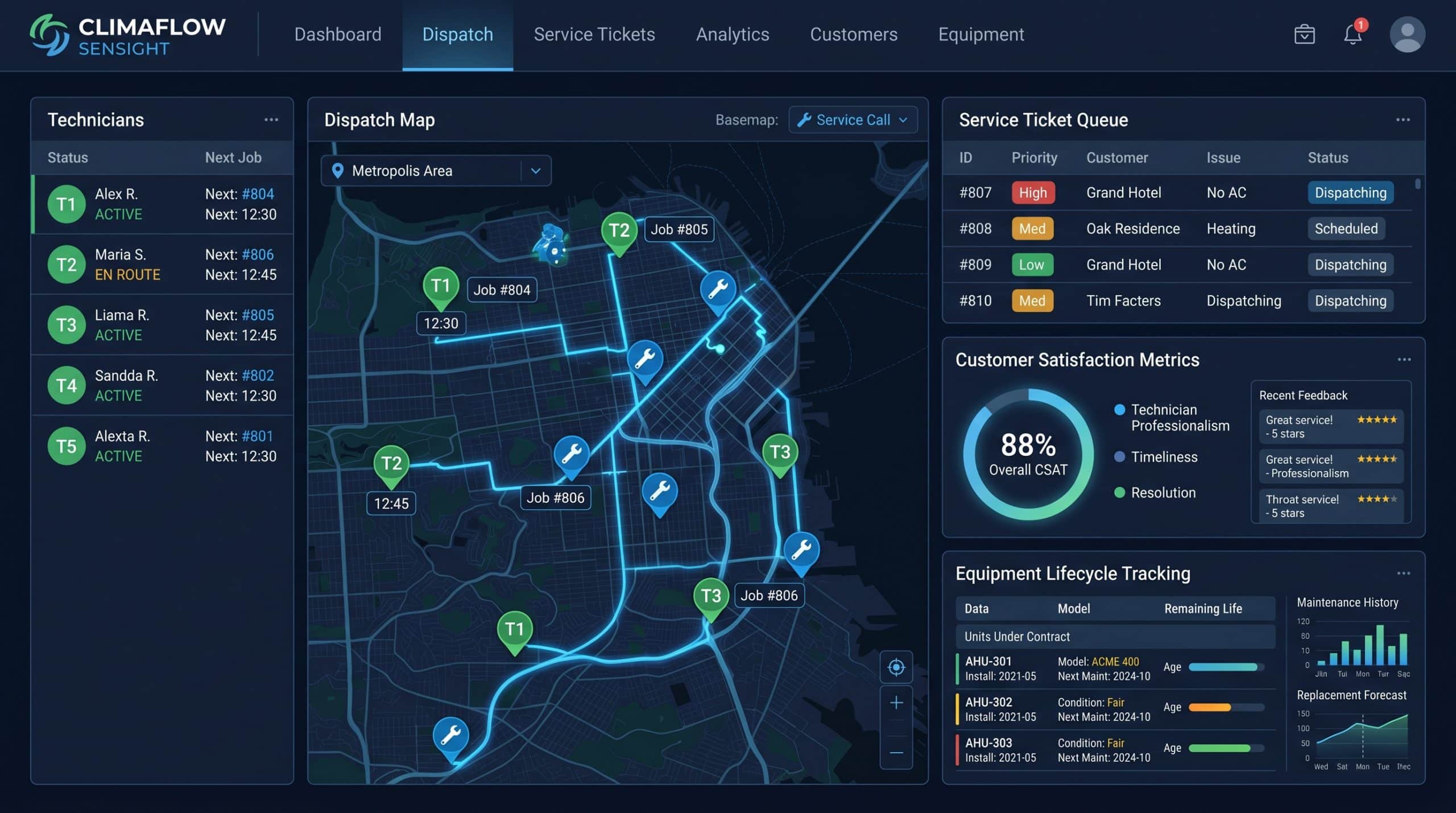
HVAC service management and dispatch dashboard

AC Repair & Emergency Cooling

Emergency AC repair door hangers should be bold, urgent, and immediately actionable. Feature your phone number in the largest possible font — when a homeowner’s AC fails on a 100-degree day, they need to call someone immediately. Emphasize: 24/7 emergency service, same-day repair availability, all-brands serviced, licensed and insured technicians, and transparent pricing with no hidden fees. Distribute during spring and summer, with rapid-deployment capability during heat waves. Target older neighborhoods where AC systems are past their warranty period and most vulnerable to failure. Include a refrigerator magnet element if budget allows — magnetic door hangers stay visible for months.

Furnace Repair & Heating Services

Heating service door hangers follow similar urgency principles as AC repair but target fall and winter distribution windows. Carbon monoxide safety messaging adds a critical safety dimension that AC campaigns lack — emphasize CO detector checks, furnace safety inspections, and the risks of operating a furnace without professional maintenance. Feature both emergency repair availability and preventive maintenance offers. In markets like Chicago, Minneapolis, Denver, and Boston, furnace campaigns should emphasize both comfort and safety — a furnace failure in subzero temperatures is not just uncomfortable, it is dangerous.

Seasonal Maintenance & Tune-Up Programs

Maintenance campaign door hangers should emphasize preventive value — regular tune-ups extend system life, improve efficiency, reduce energy bills, and prevent costly emergency breakdowns. Offer specific pricing (e.g., “Spring AC Tune-Up — $89”) rather than vague “call for pricing” language. Maintenance campaigns generate the best response rates when distributed 3-4 weeks before the relevant season begins, capturing proactive homeowners who plan ahead. Include comparison data: “Regular maintenance can reduce HVAC operating costs and extend system life by several years.” Maintenance agreement enrollment offers that bundle spring and fall services at a discounted annual rate create recurring revenue streams that build business stability.

New System Installation & Replacement

System replacement campaigns target homeowners with aging equipment — focus distribution on neighborhoods with homes built 15-20+ years ago where original HVAC systems are approaching end-of-life. Emphasize energy efficiency improvements, utility cost savings, available rebates and tax credits, and flexible financing options that make replacement affordable. Include brand partnerships — if you are a Carrier, Trane, or Lennox dealer, leverage that brand recognition. Feature SEER rating comparisons showing efficiency gains between old and new systems. These campaigns generate the highest revenue per lead of any HVAC door hanger type, but require longer sales cycles and more follow-up than repair campaigns.

Indoor Air Quality & Duct Services

Indoor air quality campaigns resonate year-round but peak during allergy season (spring), wildfire season (summer/fall in western markets), and peak winter indoor confinement. Door hangers promoting duct cleaning, air purification systems, UV germicidal lights, HEPA filtration, humidifiers, and dehumidifiers address growing consumer awareness of indoor air quality health impacts. Target families with children, seniors, and health-conscious homeowners in suburban neighborhoods. Post-pandemic awareness of airborne health risks has permanently elevated consumer interest in IAQ services, making these campaigns consistently effective regardless of season.

Smart Home & Energy Efficiency Upgrades

Technology-forward campaigns promoting smart thermostats, zoning systems, energy management solutions, and home automation integration appeal to tech-savvy homeowners and environmentally conscious consumers. Emphasize energy savings, remote control convenience, and integration with existing smart home ecosystems. Target newer neighborhoods and higher-income areas where homeowners are early technology adopters. Markets like Austin, Seattle, San Diego, and Denver have particularly strong demand for energy efficiency and smart home HVAC solutions.

Strategic Neighborhood Targeting for HVAC Door Hanger Campaigns

The difference between a mediocre HVAC door hanger campaign and an exceptional one often comes down to targeting precision. Distributing to the right neighborhoods at the right time with the right message transforms your marketing from a general expense into a predictable lead generation system. Direct to Door Marketing’s 99% U.S. zip code coverage and 32,267+ professional distributors enable precise targeting at the zip code, carrier route, and neighborhood level.

Housing Age & System Lifecycle Targeting

The age of homes in a neighborhood directly correlates with HVAC system condition and replacement probability. Target neighborhoods with homes built 15-25 years ago for system replacement campaigns — these homes likely have original equipment approaching or past expected lifespan. Homes built 8-15 years ago are prime targets for extended warranty programs, efficiency upgrades, and maintenance agreements. Newer construction (under 8 years) responds best to maintenance programs that protect manufacturer warranties. Direct to Door Marketing can help you identify target neighborhoods by construction date using publicly available housing data, ensuring your door hangers reach homeowners with the highest probability of needing your specific services.

Income & Property Value Targeting

Different HVAC service offers resonate with different income demographics. Higher-income neighborhoods are more likely to invest in premium equipment, whole-home air purification systems, zoning upgrades, and smart home integration. Middle-income neighborhoods respond strongly to financing offers, energy savings messaging, and maintenance agreements that protect against unexpected repair costs. Value-conscious neighborhoods prioritize affordability, reliability, and no-hidden-fees transparency. Align your door hanger messaging with the financial priorities of your target neighborhoods to maximize response rates and lead quality.

Weather Event Rapid Deployment

Extreme weather events create the highest-urgency HVAC service demand. When a heat wave, cold snap, or severe storm hits, homeowners experiencing system failures become immediately motivated buyers. Direct to Door Marketing’s nationwide distributor network enables rapid-deployment campaigns within 24-48 hours of weather events. Prepare weather-triggered door hanger designs in advance — pre-printed inventory with your emergency service messaging can be deployed instantly when conditions trigger demand. Markets like Phoenix (extreme heat), Chicago (extreme cold), and Houston (extreme heat and storms) are particularly responsive to weather-triggered campaigns.

Competitor Territory Campaigns

Identify neighborhoods where competitors are actively working — you will see their trucks, yard signs, and advertising — and distribute door hangers offering competitive differentiation. When a competitor is replacing systems in a neighborhood, surrounding homeowners become aware of their own HVAC systems and receptive to second opinions and competitive quotes. Door hangers distributed in areas where competitors are active capture this elevated awareness while the need for HVAC services is top-of-mind for the entire neighborhood. Emphasize your unique advantages: better warranties, more experienced technicians, faster response times, or transparent pricing that competitors do not match.

HVAC Door Hanger Marketing Case Studies

These real-world examples illustrate how HVAC companies across different markets and business models use door hanger distribution to generate measurable results. Each case study demonstrates specific strategies, targeting approaches, and business outcomes achieved through professional door hanger distribution with Direct to Door Marketing.

Case Study: Regional HVAC Company, Phoenix Metro

A mid-size HVAC company serving the greater Phoenix area wanted to increase their summer AC repair call volume in specific high-value neighborhoods. They partnered with Direct to Door Marketing to distribute 8,000 door hangers across four zip codes in Scottsdale, Chandler, Gilbert, and Tempe — targeting neighborhoods with homes built between 2000-2010 where original AC systems were approaching replacement age. The campaign featured bold emergency AC repair messaging with a first-service discount and 24/7 availability emphasis. Distribution occurred in mid-May, two weeks before the summer heat peak. The company reported a significant increase in new customer calls from the target neighborhoods during June and July compared to the prior year, with several calls directly referencing the door hanger. Multiple emergency repair calls converted to system replacement sales, each generating substantial revenue that far exceeded the entire campaign investment.

Case Study: Family-Owned HVAC Contractor, Dallas-Fort Worth

A family-owned HVAC company in Dallas-Fort Worth struggled to compete against larger companies with massive digital advertising budgets. They implemented a quarterly door hanger distribution program with Direct to Door Marketing, targeting three subdivisions in Frisco and McKinney (4,500 homes total). Spring campaigns promoted AC tune-ups, summer campaigns emphasized emergency repair availability, fall campaigns offered furnace preparation specials, and winter campaigns promoted maintenance agreement enrollment. After one full year of consistent quarterly distribution, the company had established a recognizable brand presence in all three target communities. New customer acquisition from these neighborhoods increased substantially, and maintenance agreement enrollment from the target areas grew significantly. The owner reported that door hanger distribution generated stronger customer loyalty than any digital channel because homeowners felt personally served by a company that invested in their neighborhood.

Case Study: HVAC Franchise Operation, Chicago Suburbs

A multi-location HVAC franchise in the Chicago suburbs coordinated door hanger distribution across five territories simultaneously. Each location distributed 5,000 door hangers per quarter, covering a total of 25,000 homes. The franchise headquarters provided consistent branding and messaging while individual locations customized service offers and phone numbers for local tracking. Direct to Door Marketing coordinated the multi-location campaign, ensuring consistent distribution quality across all five territories with Proof of Delivery documentation for each. After two years of quarterly distribution, the franchise reported that door hanger campaigns consistently produced leads at lower cost-per-acquisition than their Google Ads campaigns in four of five territories. The corporate office adopted the door hanger program as a recommended marketing channel for all franchise locations nationwide.

Case Study: Commercial & Residential HVAC, Atlanta Metro

An Atlanta-area HVAC company serving both residential and commercial clients used door hanger campaigns to grow their residential maintenance agreement base. They distributed 10,000 door hangers bi-monthly across eight neighborhoods in Alpharetta, Roswell, and Marietta — exclusively promoting their annual maintenance agreement program with specific pricing and benefits outlined clearly on the door hanger. The campaign included a QR code linking to an online sign-up page with autopay enrollment. Over twelve months, the company enrolled a significant number of new maintenance agreement customers attributable to the door hanger campaign, each representing hundreds of dollars in annual recurring revenue. The predictable recurring revenue from maintenance agreements transformed the company’s cash flow stability and reduced their dependence on seasonal emergency calls that had previously created revenue volatility throughout the year.

How HVAC Door Hanger Distribution Works with Direct to Door Marketing

Launching an HVAC door hanger campaign with Direct to Door Marketing is straightforward. Our process is designed to get your heating and cooling marketing materials on homeowners’ doors quickly, efficiently, and with full accountability. Here is what to expect from start to finish.

Step 1: Consultation & Targeting

Call (866) 643-4037 to speak with an HVAC account manager. We discuss your service area, target neighborhoods, campaign goals (emergency repair awareness, maintenance agreement enrollment, system replacement leads), budget, and timing. Our team recommends specific zip codes and neighborhoods based on housing age, demographics, and seasonal demand patterns that align with your campaign objectives.

Step 2: Design & Production

Provide your completed door hangers or work with our design guidance team to create HVAC-specific campaigns. We recommend including your license number, phone number in large font, seasonal service offers with specific pricing, brand certifications, financing availability, and emergency service hours. Print your door hangers with a quality printer and ship to our nearest distribution hub, or coordinate printing through our partner network.

Step 3: Distribution & Verification

Our professional distributors cover your target neighborhoods within 3-7 business days. Every distribution session is documented with Proof of Delivery photos through our AI Management Platform — you see your HVAC door hangers on actual residential doors in your service area. This verification provides the accountability that protects your marketing investment and ensures complete neighborhood coverage.

Step 4: Reporting & Optimization

After distribution, your account manager provides a comprehensive campaign report including distribution documentation, neighborhood coverage summary, and performance benchmarking. For HVAC companies running recurring seasonal campaigns, we track distribution patterns and recommend targeting adjustments based on response data. The most successful HVAC clients establish quarterly distribution programs that build cumulative brand presence across their service area throughout the year.

HVAC Door Hangers vs. Digital Advertising: A Comprehensive Comparison

HVAC companies face rising digital advertising costs — Google Ads for HVAC keywords like “AC repair near me” and “furnace repair” cost $30-$100+ per click in competitive markets. Door hanger distribution offers a complementary channel that reaches homeowners before they search, building brand awareness that drives both direct response and future search behavior.

FactorHVAC Door HangersGoogle/Facebook Ads
Cost Per LeadTypically lower than digital in competitive HVAC markets$30-$150+ per lead in major metros (rising annually)
TargetingSpecific neighborhoods, zip codes, housing typesGeographic + demographic + search intent
Guaranteed DeliveryProof of Delivery photos on every doorImpressions counted even if scrolled past
CompetitionUsually the only HVAC piece on the doorCompeting with 3-4 other HVAC ads on every search
TangibilityPhysical — saved on fridge, kept for referenceDigital — disappears with a scroll
Brand BuildingCreates physical brand presence in neighborhoodsBuilds digital impressions but no physical presence
Emergency RecallDoor hanger on fridge = first call during emergencyMust search and compete with ads during crisis
Lead Exclusivity100% exclusive — only your company on the pieceShared with competitors in search results
Timing ControlDistribute before seasonal peaks proactivelyReactive — captures demand after homeowner searches
VerificationAI Platform Proof of Delivery photosClick fraud risk, bot traffic concerns

The most successful HVAC companies use both channels synergistically: door hangers create proactive neighborhood awareness before seasonal demand peaks, while digital ads capture reactive search intent when homeowners actively need service. This dual-channel approach captures leads at both ends of the buying journey — awareness and intent — maximizing total lead volume while diversifying lead sources for business stability.

HVAC Door Hangers vs. Direct Mail Postcards

Many HVAC companies choose between door hangers and direct mail postcards for their physical marketing campaigns. Understanding the strategic differences helps you allocate your budget for maximum impact in your service area.

FeatureDoor HangersDirect Mail / EDDM
VisibilityOn front door — seen immediately when returning homeIn mailbox mixed with bills, catalogs, junk mail
Delivery VerificationProof of Delivery photos via AI PlatformNo delivery verification available from USPS
SpeedDistributed within 3-7 business daysUSPS processing adds 5-14+ business days
Emergency TimingRapid deployment during weather events (24-48 hrs)Too slow for weather-triggered campaigns
Physical Presence3D — hangs on door handle, cannot be ignoredFlat — easily stacked and discarded with other mail
Targeting PrecisionSpecific streets, subdivisions, custom areasUSPS carrier routes (less precise)
PerceptionPersonal, hand-delivered, local business feelMass-produced, bulk mail perception
Refrigerator SavingHigh — physical shape encourages savingLower — flat postcards less likely to be saved

HVAC Door Hanger Design Tips for Maximum Response

The design of your HVAC door hanger directly influences response rates. After distributing for thousands of HVAC companies over three decades, Direct to Door Marketing has identified the design elements that consistently drive the strongest response across heating and cooling campaigns.

Phone Number Dominance

Your phone number should be the largest, most prominent element on the door hanger — larger than your company name, larger than any offer, larger than any image. When a homeowner’s AC fails on a Saturday afternoon or their furnace stops working at midnight, they need to find a phone number instantly. Design your door hanger so the phone number is readable from arm’s length without squinting. Include the number on both sides of a double-sided door hanger. This single design principle — phone number dominance — generates more HVAC service calls than any other design element.

Service Offer Specificity

Vague messaging like “Call us for all your HVAC needs” generates significantly fewer calls than specific service offers with clear pricing. “Spring AC Tune-Up — $89” outperforms “Call for AC service.” “24/7 Emergency AC Repair — No Overtime Charges” outperforms “We fix ACs.” Specificity creates confidence — homeowners know exactly what they will get and what it will cost before picking up the phone. Include your most compelling seasonal offer prominently, supported by a concise list of additional services you provide. Specific pricing reduces price anxiety that prevents homeowners from calling.

Trust Signals & Credentials

HVAC is an industry where homeowners are particularly concerned about contractor legitimacy. Include your state contractor license number, NATE certification badges, manufacturer authorizations (Carrier, Trane, Lennox dealer logos), BBB accreditation, years in business, insurance and bonding information, and any industry awards or recognitions. These trust signals differentiate you from unlicensed operators and fly-by-night companies that proliferate during extreme weather events. In a single glance, a homeowner should be able to confirm that your company is legitimate, established, and qualified.

Seasonal Urgency & Color Psychology

Use color psychology to reinforce seasonal messaging. Cooling campaigns benefit from blues, whites, and cool tones that subconsciously communicate relief from heat. Heating campaigns perform well with warm reds, oranges, and amber tones that signal warmth and comfort. Emergency campaigns should use red and yellow urgency colors with bold typography. Seasonal imagery — snowflakes for winter, sun and thermometer for summer — creates instant visual recognition of the campaign’s relevance to the current season. The combination of seasonal colors and urgency messaging creates an emotional response that motivates homeowners to act now rather than procrastinate.

AI Management Platform & Proof of Delivery for HVAC Campaigns

Direct to Door Marketing’s proprietary AI Management Platform provides the distribution accountability that HVAC companies demand. Unlike competitors who rely on simple route verification or unverifiable delivery claims, our platform requires photographic Proof of Delivery documentation for every distribution session — ensuring your HVAC door hangers actually reach the homeowners who need your services.

Proof of Delivery Photos

Our distributors capture photographs documenting your HVAC door hangers placed on actual residential front doors in your target neighborhoods. These photos are uploaded to our AI Management Platform for review and verification. You receive access to view every delivery photo — providing visual confirmation that your marketing materials reached their intended audience. This level of accountability is unique to Direct to Door Marketing and eliminates the uncertainty that plagues other distribution methods.

Distribution Tracking & Reporting

Our platform tracks distribution progress in real-time, providing visibility into which neighborhoods have been covered, total pieces distributed, and campaign completion status. After each campaign, your account manager provides a comprehensive distribution report including neighborhood-by-neighborhood coverage documentation, total pieces placed, and Proof of Delivery verification. For HVAC companies running seasonal campaigns across multiple service areas, this reporting provides the data needed to evaluate campaign performance and optimize future targeting decisions.

Quality Assurance & Accountability

Every distributor in our 32,267+ network is vetted, trained, and held accountable through our AI Management Platform’s verification requirements. Distributors who fail to provide adequate Proof of Delivery documentation are flagged for review. This quality assurance system ensures that your HVAC marketing investment produces actual neighborhood coverage — not empty promises. When you invest in door hanger distribution with Direct to Door Marketing, you know your investment is protected by the most advanced distribution accountability system in the industry.

Door Hanger Strategies by HVAC Company Type

Different HVAC business models require different door hanger marketing approaches. Whether you are a solo technician building a local customer base or a multi-state franchise operation coordinating regional campaigns, door hanger distribution can be customized to your specific business structure and growth objectives.

Solo Operators & Small Contractors

Independent HVAC technicians and small contracting companies benefit most from focused, hyper-local door hanger campaigns that build a strong customer base within a defined service area. Start with 2,500-5,000 door hangers distributed to neighborhoods within a 15-minute drive of your home base. Emphasize the personal service advantages that large companies cannot match: “owner-operated,” “your neighbor in HVAC,” direct access to the technician who will service your home. Consistent quarterly distribution to the same neighborhoods builds the personal brand recognition that generates referrals — the lifeblood of small HVAC businesses. Direct to Door Marketing’s programs accommodate small-quantity campaigns that fit independent contractor budgets.

Mid-Size HVAC Companies

Companies with 5-25 technicians and established service areas have the budget and operational capacity to run larger, more strategic door hanger campaigns. Distribute 5,000-15,000 door hangers per campaign across multiple target neighborhoods, with different messaging for different areas based on housing stock, demographics, and service history. Coordinate door hanger distribution with your dispatch routing — distribute to neighborhoods where your trucks already operate, reinforcing brand visibility from multiple touchpoints. Maintenance agreement enrollment campaigns scale efficiently at this level, with door hangers driving online sign-ups that your office staff processes without consuming technician time.

Franchise Operations

HVAC franchises (One Hour Heating & Air, Aire Serv, ARS/Rescue Rooter, etc.) can leverage corporate brand recognition while customizing local door hanger campaigns for individual territories. Franchisees benefit from corporate-approved design templates that maintain brand consistency while allowing local phone numbers, service offers, and territory-specific messaging. Direct to Door Marketing coordinates multi-location franchise campaigns with centralized brand management and territory-specific distribution. Franchise headquarters can implement system-wide door hanger programs as recommended marketing channels, providing franchisees with a proven lead generation tool that supplements national advertising with local neighborhood presence.

Multi-Trade Home Service Companies

Companies offering HVAC alongside plumbing, electrical, or other home services can leverage door hangers to cross-promote multiple service lines on a single piece. A door hanger promoting “heating tune-up + plumbing inspection” or “whole-home comfort assessment” creates multi-service awareness that increases average ticket value per customer. Cross-promotion door hangers also improve campaign ROI by amortizing distribution costs across multiple service lines. Target neighborhoods where your existing HVAC customers live to upsell additional services, or distribute to new areas where multi-service offerings differentiate you from single-trade competitors who cannot provide the same comprehensive home comfort solutions.

Weather-Triggered Emergency HVAC Door Hanger Campaigns

Extreme weather events create the most urgent HVAC service demand and the highest-value door hanger distribution opportunities. When temperatures spike above 100°F or plunge below 20°F, homeowners experiencing HVAC system failures need help immediately. HVAC companies that distribute emergency service door hangers during these events capture high-value repair and replacement leads that would otherwise go to competitors or emergency search results.

Heat Wave Rapid Deployment

When extreme heat events are forecast, pre-position emergency AC repair door hangers with Direct to Door Marketing for rapid deployment within 24-48 hours. Feature bold messaging: “AC DOWN? We’re Available 24/7 — Same-Day Emergency Repair.” Target neighborhoods with older housing stock where AC systems are most vulnerable to failure under extreme load conditions. Markets like Phoenix, Dallas, Houston, Las Vegas, and Tampa experience the highest demand for heat wave emergency campaigns.

Cold Snap Emergency Heating

When polar vortex events or severe cold snaps are forecast for northern and midwestern markets, deploy emergency furnace repair door hangers immediately. Emphasize carbon monoxide safety concerns alongside emergency heating repair availability. Markets like Chicago, Minneapolis, Denver, Boston, and Detroit are prime targets for winter emergency heating campaigns. Include space heater safety warnings as a value-added element that demonstrates genuine concern for homeowner welfare.

Post-Storm Recovery Campaigns

Severe storms — hurricanes, tornadoes, ice storms — can damage HVAC equipment, knock out power to systems, and create surge damage to compressors and electrical components. Post-storm door hanger campaigns distributed within days of weather events capture homeowners who need HVAC assessment and repair as part of their overall recovery. Target affected neighborhoods with messaging: “Storm Damage to Your AC or Heating System? Free Assessment — Call Today.” Markets in hurricane-prone Miami, Houston, Tampa, and New Orleans are particularly responsive to post-storm HVAC campaigns.

Using Door Hangers to Build Your HVAC Maintenance Agreement Base

Maintenance agreements are the foundation of a financially stable HVAC business — they provide predictable recurring revenue, reduce seasonal cash flow volatility, create ongoing customer relationships that prevent competitor encroachment, and generate replacement leads when technicians identify aging equipment during routine service visits. Door hanger distribution is one of the most effective channels for growing your maintenance agreement base because it reaches homeowners who are not actively searching for HVAC service but would benefit from proactive maintenance programs.

Program Structure & Pricing

Design your maintenance agreement door hanger around a clear, specific program offer that homeowners can evaluate without calling for pricing. Include: annual cost or monthly payment option, number of included service visits (typically two per year — one AC, one heating), specific services included in each visit (inspection checklist, filter replacement, efficiency testing), priority scheduling benefits, repair discount percentages, parts warranty extensions, and any bonus features (free diagnostic with agreement, no overtime charges). The more specific and transparent your program details, the higher your enrollment conversion rate will be.

Value Proposition Messaging

Frame your maintenance agreement as a financial protection program, not just a service contract. Messaging like “Protect Your HVAC Investment” or “Avoid Costly Emergency Repairs” resonates more powerfully than “Buy Our Maintenance Plan.” Quantify the value: if your agreement costs a specific amount annually and the average emergency repair is significantly more, the protection value is clear. Include statistics about how regularly maintained systems experience fewer breakdowns, lower energy consumption, and longer equipment lifespan compared to unmaintained systems. This value-first approach positions the maintenance agreement as a smart financial decision rather than an additional expense.

HVAC Door Hanger Copy That Generates Service Calls

The words on your HVAC door hanger directly influence whether homeowners pick up the phone, scan the QR code, or visit your website. Effective HVAC copy combines urgency, trust, specificity, and clear calls to action within a limited space. Here is a comprehensive guide to writing door hanger copy that motivates homeowners to schedule service.

Headlines That Create Urgency

HVAC door hanger headlines should create immediate relevance by connecting to the homeowner’s current seasonal reality. “Is Your AC Ready for Summer?” in April creates preparation urgency. “Don’t Wait Until Your Furnace Fails” in September creates prevention urgency. “Your Neighbor Just Upgraded Their HVAC System” creates social proof urgency. Question headlines that highlight potential problems outperform generic company introductions: “When Was the Last Time Your AC Was Inspected?” prompts homeowners to acknowledge a potential issue, which is the first step toward calling for service. Temperature-specific headlines like “106°F Forecast This Weekend — Is Your AC Ready?” connect directly to the homeowner’s immediate concerns.

Service Descriptions That Build Value

Describe your services in terms of homeowner benefits, not technical features. “Our 21-Point AC Inspection Catches Small Problems Before They Become Expensive Emergencies” is more compelling than “We offer AC inspections.” Frame every service as protection, savings, or comfort improvement: “Reduce Your Energy Bills with a High-Efficiency System Upgrade” or “Sleep Comfortably All Winter with Our Guaranteed Heating System Tune-Up.” Include specific details that demonstrate thoroughness: “Our technicians check refrigerant levels, clean condenser coils, inspect electrical connections, test thermostat calibration, and evaluate overall system performance — every visit.” Specificity builds confidence in your professionalism.

Pricing & Offer Presentation

Specific pricing on HVAC door hangers dramatically outperforms “call for pricing” language. Homeowners are more likely to call when they already know the approximate cost: “$89 Spring AC Tune-Up Special” generates more calls than “Affordable AC Service.” If your pricing is competitive, feature it prominently. If you compete on value rather than price, frame your offer as savings: “Save $50 — Schedule Your Tune-Up Before May 1st.” Limited-time offers create urgency: “This Week Only” or “First 50 Customers” messaging motivates immediate action rather than procrastination. Always include any financing options for larger services — “0% Financing Available for System Replacement” removes the cost barrier that prevents many homeowners from calling.

Emergency Service Messaging

Emergency service copy should be bold, clear, and instantly actionable. “24/7 Emergency HVAC Repair — We Answer the Phone When Others Don’t” communicates both availability and reliability. Include response time commitments if you can deliver: “Same-Day Service — Call Before Noon, We’re There Today.” Differentiate your emergency service from competitors: “No Overtime Charges — Same Rate Day, Night, Weekend, Holiday” or “Real Technicians Answer Our Phone — No Call Centers, No Runaround.” Emergency messaging should be placed where homeowners will find it during a crisis — both sides of the door hanger, with phone number visible regardless of which side faces out.

Common HVAC Door Hanger Marketing Mistakes (and How to Avoid Them)

After distributing door hangers for thousands of HVAC companies over three decades, Direct to Door Marketing has identified the most common mistakes that undermine campaign effectiveness. Avoiding these pitfalls will help you launch more effective campaigns from day one.

Mistake #1: Missing the Seasonal Window

The most costly timing mistake HVAC companies make is distributing door hangers during peak season rather than before it. When you distribute AC tune-up door hangers in July, most homeowners have already scheduled service or are dealing with emergency repairs. Distributing in March or early April captures proactive homeowners who plan ahead and generates a pipeline of scheduled appointments before the rush. Similarly, furnace campaigns in November are too late — distribute in September when homeowners are beginning to think about winter preparation. Lead your market by 4-6 weeks to maximize campaign response.

Mistake #2: Phone Number Too Small

Many HVAC companies design beautiful door hangers with professional graphics, compelling offers, and strong branding — then bury their phone number in small font at the bottom. When a homeowner’s AC fails at 2 AM and they are fumbling for the door hanger they saved on their refrigerator, they need to find your phone number instantly in dim lighting while stressed. Make your phone number the single largest element on the door hanger — minimum 24-point font, ideally larger. This one design change alone can significantly increase your call volume from door hanger campaigns.

Mistake #3: No Tracking Mechanisms

Distributing HVAC door hangers without any lead tracking method makes it impossible to measure campaign ROI or optimize future campaigns. Every door hanger should include at least one trackable element: a unique phone number for each campaign, a QR code linking to a campaign-specific landing page, a promo code that customers mention when calling, or a dedicated URL. Without tracking, you are investing blindly. With tracking, you can calculate your exact cost-per-lead, compare performance across different neighborhoods, test different offers, and make data-driven decisions about future marketing investments.

Mistake #4: One-Time Campaigns

Many HVAC companies distribute door hangers once, see moderate results, and conclude that door hanger marketing does not work. Like all brand-building marketing, door hanger effectiveness compounds with consistency. A homeowner who sees your door hanger once may not need service at that moment. A homeowner who has received your door hanger four times across four seasons knows your company name, trusts your brand, and calls you when the need arises. Commit to a minimum of four seasonal campaigns per year — spring AC, summer emergency, fall furnace, winter emergency — to build the cumulative brand presence that generates consistent lead flow.

Mistake #5: Generic, Non-Local Content

Door hangers that look like they could be from any HVAC company in any city generate weaker response than locally specific campaigns. Include your city name, neighborhood references, local weather patterns, and community connections in your copy. “Serving [Your City] Families Since [Year]” creates local trust. Mentioning specific neighborhoods you serve makes homeowners feel you are their local provider, not a distant corporate entity. Include your physical address if you have a local office — homeowners trust companies they can find in their community.

Mistake #6: Using Unverified Distributors

The cheapest distribution option is rarely the most effective. HVAC companies that hire neighborhood teenagers, unvetted Craigslist workers, or discount distribution services frequently discover that their door hangers never reached their intended audience. Without Proof of Delivery documentation, you have no way to verify that your investment produced actual neighborhood coverage. Direct to Door Marketing’s AI Management Platform with mandatory Proof of Delivery photos provides the accountability that protects your marketing investment and ensures your HVAC door hangers actually reach homeowners’ front doors — verified with photographic evidence.

HVAC Door Hanger Marketing Across Major U.S. Markets

Direct to Door Marketing has been distributing door hangers for HVAC companies in every major U.S. market since 1995. Each region has unique climate patterns, heating and cooling demands, seasonal timing, and competitive landscapes that influence door hanger campaign strategy. Here is how HVAC door hanger marketing performs across America’s top HVAC markets.

Phoenix / Sun Belt

The Phoenix market and Sun Belt region represent the highest-volume AC service markets in the country. Summer temperatures exceeding 110°F create extreme demand for emergency AC repair, making door hanger campaigns distributed in April-May among the highest-response HVAC campaigns nationwide. Year-round cooling demand (Phoenix AC systems run 8+ months annually) means AC-focused campaigns are effective across most of the calendar year. Similar patterns apply across Las Vegas, Dallas, Houston, San Antonio, and Austin.

Chicago / Midwest

Chicago and Midwest markets have the most balanced heating and cooling demand, creating year-round HVAC marketing opportunities. Extreme cold (polar vortex events with subzero temperatures) generates urgent furnace repair demand that rivals Sun Belt AC emergency calls. Summer humidity and heat waves create strong AC demand as well. HVAC companies in Minneapolis, Detroit, Kansas City, and St. Louis benefit from four distinct seasonal campaigns, maximizing door hanger distribution opportunities throughout the year.

Miami / Southeast

Miami and Southeast markets feature nearly year-round AC demand with minimal heating requirements. AC systems in South Florida run almost continuously, creating high maintenance and replacement demand. Hurricane season (June-November) creates post-storm HVAC assessment opportunities. Atlanta, Tampa, Orlando, and New Orleans share similar patterns with slightly more heating demand during brief winter periods. Bilingual campaigns (English/Spanish) are essential in Miami and increasingly important across the Southeast.

Boston / Northeast

Boston and Northeast markets are heavily heating-dominated, with long winters creating extended furnace service demand. Older housing stock in cities like Philadelphia, New York, and Washington DC often features aging boiler systems, oil-to-gas conversions, and complex multi-zone heating that generates specialized service demand. Summer AC campaigns have grown significantly as extreme heat events become more frequent in the Northeast, creating a secondary peak season that supplements traditional winter heating demand.

Denver / Mountain West

Denver and Mountain West markets feature extreme temperature swings — 100°F+ summers and subzero winter lows — creating strong year-round HVAC demand. Altitude affects AC system performance (thinner air reduces cooling capacity), creating unique maintenance requirements. Rapid population growth in Front Range communities provides continuous new customer acquisition opportunities. Indoor air quality concerns from wildfire smoke seasons (increasingly common in western markets) drive air purification and filtration campaigns.

Seattle / Pacific Northwest

Seattle and Pacific Northwest markets have historically been heating-focused, but recent extreme heat events (2021 heat dome with 108°F+ temperatures) have dramatically increased AC demand in a region where many homes lack central air conditioning. Door hanger campaigns promoting ductless mini-split installations and heat pump systems generate strong response in the PNW, where homeowners are upgrading from heating-only systems to year-round comfort solutions. Energy efficiency and environmental messaging resonate strongly in these markets.

Understanding Your HVAC Door Hanger Campaign ROI

HVAC companies investing in door hanger distribution should evaluate returns across multiple revenue streams — not just immediate service calls. The high customer lifetime value in the HVAC industry means that even modest new customer acquisition rates from door hanger campaigns can generate substantial return on investment when measured over the full customer relationship lifecycle.

Customer Lifetime Value Framework

A single new HVAC customer acquired through a door hanger campaign can generate $10,000-$15,000+ in lifetime revenue: annual maintenance agreements ($150-300/year for multiple years), seasonal and emergency repair calls ($200-1,500+ per visit), system replacement ($5,000-$15,000+ per system when the time comes), and referrals to friends and neighbors (additional lifetime value from each referred customer). When evaluating door hanger ROI, calculate the full lifetime value of acquired customers — not just the revenue from their first service call. This lifetime perspective transforms door hanger distribution from a marketing expense into a customer acquisition investment with exceptional long-term returns.

Campaign Performance Measurement

Track these metrics for every HVAC door hanger campaign: total pieces distributed, total inbound calls from campaign tracking numbers, QR code scans and landing page visits, appointment bookings attributable to the campaign, completed service calls from campaign leads, maintenance agreement enrollments, total revenue generated from campaign-sourced customers, and cost-per-acquired-customer. Compare these metrics across campaigns to identify which seasons, neighborhoods, and offers generate the strongest returns. Over time, this data enables increasingly precise campaign optimization that maximizes ROI with each successive distribution cycle.

Getting Started: Your HVAC Door Hanger Campaign Roadmap

Whether you are launching your first HVAC door hanger campaign or scaling an established program, this roadmap guides you from planning through execution and optimization. Direct to Door Marketing’s HVAC account managers are available at (866) 643-4037 to customize this framework for your specific market, budget, and business goals.

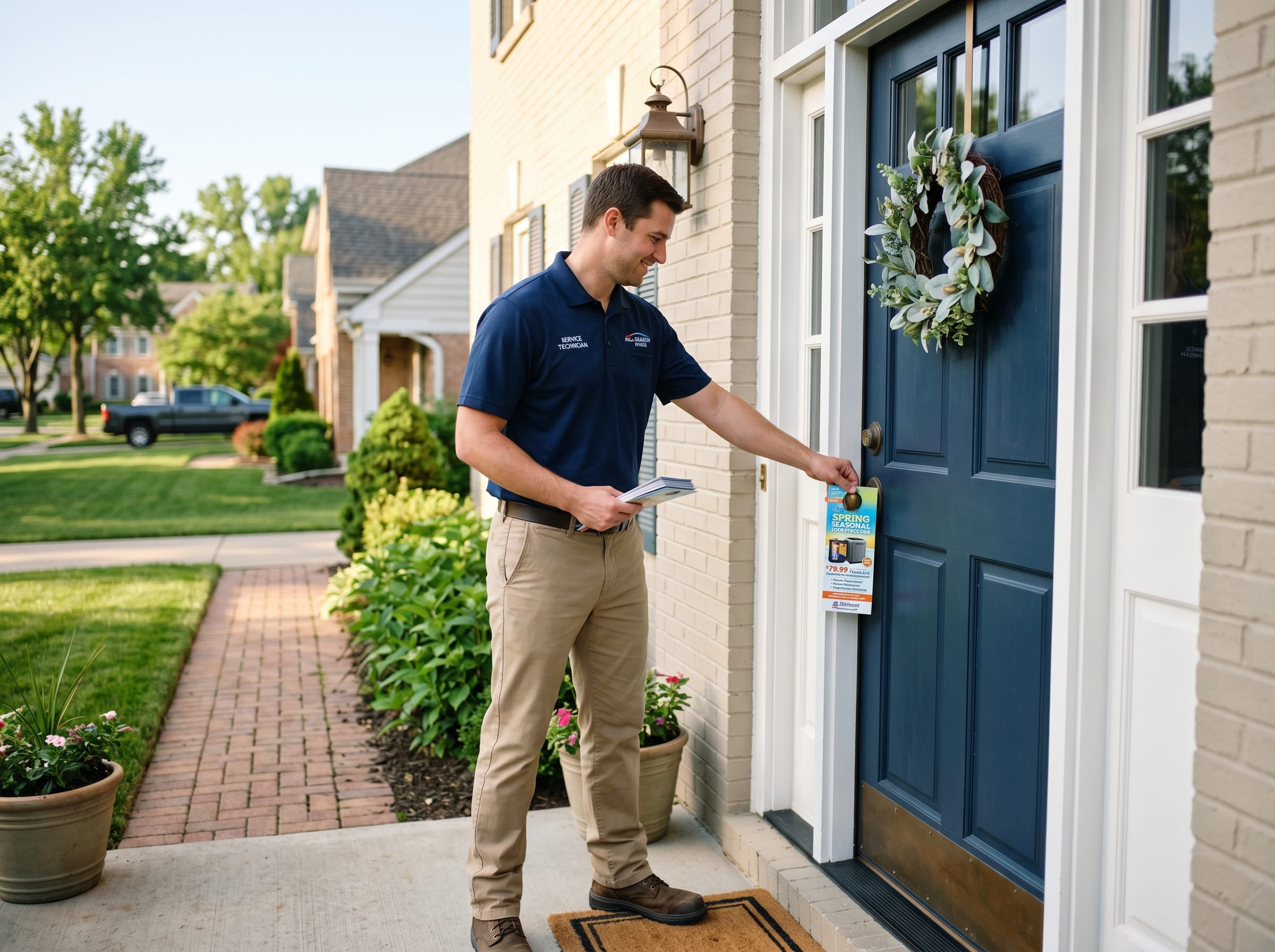
HVAC service door hanger being placed on residential front door

Week 1: Strategy & Targeting

Define your campaign objectives: Are you driving seasonal tune-up appointments, building emergency service awareness, growing your maintenance agreement base, or promoting system replacements? Identify target neighborhoods based on housing age, income demographics, and proximity to your service area. Determine campaign quantity — typically 2,500-10,000 pieces for initial campaigns. Call (866) 643-4037 for a complimentary consultation with an HVAC account manager who will help you select the highest-potential target areas for your specific services.

Week 2: Design & Production

Design your door hanger with phone number prominence, specific service offers with pricing, trust credentials, seasonal urgency messaging, and a clear call to action. Include your license number, insurance information, brand certifications, and years in business. Set up tracking: unique phone number, QR code, campaign-specific landing page. Print on quality cardstock — minimum 14pt for professional appearance. Ship completed door hangers to our nearest distribution hub.

Week 3-4: Distribution & Monitoring

Direct to Door Marketing assigns professional distributors to your target neighborhoods. Distribution completes within 3-7 business days with Proof of Delivery photos captured through our AI Management Platform. Monitor incoming calls and website traffic from your tracking mechanisms. Log all leads in your CRM with campaign source attribution. Your account manager provides distribution completion documentation with neighborhood coverage verification.

Ongoing: Seasonal Program

Establish a quarterly distribution cadence aligned with seasonal HVAC demand: spring AC tune-up (March-April), summer emergency AC (June-July), fall furnace prep (September-October), and winter emergency heating (December-January). Track cumulative results across seasons — brand recognition and response rates build with each distribution cycle. Supplement scheduled campaigns with rapid-deployment weather event campaigns as opportunities arise. After four quarterly campaigns, analyze year-one data to optimize targeting, messaging, and distribution timing for your second year.

Why America’s Top HVAC Companies Choose Direct to Door Marketing

Since 1995, Direct to Door Marketing has been the trusted door hanger and flyer distribution partner for thousands of HVAC contractors, heating and cooling companies, and home comfort service providers across the United States. From independent technicians building their first customer base to national franchise operations coordinating multi-market campaigns, our combination of massive distributor network, AI-powered delivery verification, and three decades of home services marketing expertise makes us the clear industry leader for HVAC door hanger campaigns.

Unmatched Scale & Rapid Deployment

With 32,267+ professional distributors and 99% U.S. zip code coverage, Direct to Door Marketing distributes in virtually every residential neighborhood in America. For HVAC companies, our scale provides a critical capability: rapid deployment during extreme weather events. When a heat wave or cold snap creates emergency service demand, our network can deploy your door hangers to target neighborhoods within 24-48 hours — capturing high-value emergency leads during the peak urgency window. No other distribution company matches our speed, scale, and geographic reach for weather-triggered HVAC campaigns.

AI Management Platform with Proof of Delivery

HVAC companies demand accountability for every marketing dollar. Direct to Door Marketing delivers it through our proprietary AI Management Platform with mandatory Proof of Delivery photos. Unlike companies that rely on honor systems or unverifiable delivery claims, our platform provides visual verification that your HVAC door hangers reached actual residential doors in your target neighborhoods. You see the evidence. You know your investment produced real neighborhood coverage. This accountability is unique to Direct to Door Marketing and protects your marketing budget from the distribution uncertainty that plagues other methods.

30+ Years of Home Services Expertise

Direct to Door Marketing has been distributing for HVAC companies since our founding in 1995. We understand seasonal campaign timing, emergency weather deployment, maintenance agreement marketing, system replacement lead generation, and the unique targeting strategies that drive results for heating and cooling companies specifically. Our account managers provide HVAC-specific campaign recommendations based on three decades of distribution data across every major HVAC market in America.

Flexible Programs for Every HVAC Business

Whether you are a solo technician launching a 2,500-piece neighborhood campaign or a franchise operation ordering 50,000+ pieces across multiple markets, Direct to Door Marketing has a program structured for your needs. We offer single-campaign distribution for one-time promotions, quarterly seasonal programs with volume pricing, annual agreements for committed HVAC clients, and enterprise programs for multi-location and franchise operations. Every program includes full Proof of Delivery documentation and dedicated account management. Call (866) 643-4037 or request your free quote to get started.

Frequently Asked Questions: HVAC Door Hanger Distribution

Get answers to the most common questions HVAC contractors and heating and cooling companies ask about door hanger distribution and working with Direct to Door Marketing.

HVAC door hanger marketing is a targeted advertising strategy where heating, ventilation, and air conditioning companies distribute promotional door hangers directly to residential homes in specific neighborhoods and service areas. These door hangers promote services like AC repair, furnace maintenance, seasonal tune-ups, new system installations, indoor air quality services, and emergency repair availability. With Direct to Door Marketing, campaigns are distributed by professional distributors who provide Proof of Delivery photos through our AI Management Platform, ensuring every door hanger reaches its intended audience. Distribution typically completes within 3-7 business days of receiving your materials.

HVAC door hanger distribution costs vary based on quantity, geographic area, housing density, and campaign frequency. Direct to Door Marketing offers competitive per-piece pricing with volume discounts for larger campaigns and recurring seasonal programs. Quarterly programs receive preferential pricing compared to one-time campaigns. For a personalized quote based on your specific service area, distribution quantity, and campaign schedule, call (866) 643-4037 or request a free quote online.

The best times for HVAC door hanger distribution are 4-6 weeks before seasonal demand peaks: early March for spring AC tune-up campaigns, mid-August for fall furnace preparation campaigns, and immediately during extreme weather events for emergency service campaigns. Year-round distribution with seasonal messaging changes builds the strongest brand presence. The biggest timing mistake HVAC companies make is distributing during peak season rather than before it — proactive homeowners who schedule in advance are more valuable customers than those calling in crisis.

Most HVAC companies distribute between 2,500 and 10,000 door hangers per campaign. For targeted neighborhood campaigns focusing on specific zip codes or subdivisions, 2,500-5,000 pieces provides strong coverage. For broader service area campaigns or seasonal promotions, 5,000-10,000+ pieces maximizes reach. Start with a focused campaign in your highest-potential neighborhoods and expand based on response data. Direct to Door Marketing’s account managers help you determine the optimal quantity for your specific market and budget.

Yes. Direct to Door Marketing’s 32,267+ distributor network enables rapid-deployment campaigns within 24-48 hours of weather events. When heat waves, cold snaps, or severe storms create emergency HVAC service demand, we can mobilize distributors to your target neighborhoods quickly. We recommend pre-printing emergency campaign door hangers with your branding and emergency service messaging so they are ready for immediate deployment when weather conditions trigger demand. This preparedness allows you to capture the highest-urgency leads during the critical first 48 hours of extreme weather events.

Effective HVAC door hangers include: your phone number in the largest possible font (24pt minimum), company name and logo, state contractor license number, specific service offers with pricing, 24/7 emergency service availability, list of services offered, trust signals (years in business, certifications, manufacturer authorizations, insurance), seasonal urgency messaging, financing availability for larger services, QR code linking to your website or special offer page, and a clear call to action. Both sides should feature your phone number so it is visible regardless of which side faces the homeowner.

Implement multiple tracking mechanisms: a dedicated phone number unique to each campaign (Google Voice or call tracking service), QR codes linking to campaign-specific landing pages, promo codes that customers mention when calling, and CRM tagging for all incoming leads. Track total calls, appointments booked, services completed, revenue generated, and maintenance agreements enrolled from each campaign. Over time, this data enables precise ROI calculation and campaign optimization. Direct to Door Marketing also provides Proof of Delivery documentation verifying your distribution coverage.

Direct to Door Marketing provides HVAC door hanger distribution across the entire United States with 99% zip code coverage and 32,267+ professional distributors. We serve all major metropolitan areas including Phoenix, Dallas, Houston, Chicago, Miami, Atlanta, Denver, Los Angeles, New York, Boston, Seattle, and hundreds more.

Door hangers and home service lead platforms serve different functions. Angi and HomeAdvisor provide shared leads from homeowners actively searching for service — but you compete with multiple contractors for the same lead, and per-lead costs are substantial. Door hanger campaigns generate exclusive leads (no sharing), build brand awareness before the homeowner needs service, and create the “top of mind” position that generates direct calls rather than platform-mediated leads. Many HVAC companies report that door hanger-generated customers have higher lifetime value because they developed a brand relationship before their first service call, leading to stronger loyalty and more maintenance agreement enrollments.

Door hangers are primarily designed for residential properties where they hang on front door handles. For commercial HVAC marketing, door hangers can work for small commercial properties with accessible front doors — retail shops, restaurants, small office buildings, and medical offices. For larger commercial and industrial properties, other marketing channels (direct mail, digital, networking) are typically more effective. Many HVAC companies that serve both residential and commercial markets use door hangers for their residential campaigns while employing different strategies for commercial accounts.

The optimal frequency for HVAC door hanger distribution is quarterly, aligned with seasonal transitions: spring AC season (March-April), summer peak (June-July), fall heating preparation (September-October), and winter emergency awareness (December-January). This quarterly cadence ensures year-round brand presence and captures demand at every seasonal touchpoint. HVAC companies with larger budgets may distribute monthly for maximum brand saturation. Additionally, weather-triggered emergency campaigns should supplement your regular schedule whenever extreme weather events create high-urgency service demand.

Three factors: First, our AI Management Platform with Proof of Delivery photos provides visual verification that no other company offers. Second, our 32,267+ distributor network with 99% U.S. zip code coverage enables rapid deployment in virtually any market — critical for weather-triggered HVAC campaigns. Third, our 30+ years since 1995 include deep home services expertise — our account managers understand HVAC seasonal timing, emergency deployment strategies, and the targeting approaches that generate the strongest response for heating and cooling companies specifically.

Absolutely. Direct to Door Marketing coordinates multi-location campaigns for HVAC franchises nationwide. We manage corporate brand consistency while allowing territory-specific phone numbers, service offers, and pricing. Centralized reporting provides franchise headquarters with performance data across all locations, while individual franchisees receive territory-specific distribution documentation. Our enterprise program managers coordinate timing, materials, and distribution schedules across all participating locations. Contact us at (866) 643-4037 for franchise and multi-location pricing.

Yes. Direct to Door Marketing offers volume-based and frequency-based pricing programs for HVAC companies committed to recurring seasonal campaigns. Quarterly programs, semi-annual contracts, and annual agreements all receive preferential pricing compared to one-time campaign rates. Multi-location and franchise programs offer additional volume discounts. Contact our HVAC team at (866) 643-4037 to discuss recurring campaign pricing for your specific distribution volume and schedule.

Getting started is simple. Call (866) 643-4037 to speak with an HVAC account manager, or request your free quote online. During your initial consultation, we discuss your service area, campaign goals, seasonal timing, budget, and target neighborhoods. Our team provides a customized campaign proposal with recommended distribution quantities, pricing, and scheduling. Once your door hangers are printed and shipped to our facility, we assign professional distributors and begin distribution — typically within 3-7 business days. You receive Proof of Delivery documentation through our AI Management Platform as distribution progresses.

Many HVAC companies are increasingly conscious of their environmental impact. Door hangers can be printed on recycled cardstock, FSC-certified paper, or other sustainably sourced materials. Additionally, door hangers are more environmentally efficient than direct mail because they are hand-delivered (no postal processing or transportation infrastructure) and there is no plastic packaging. For HVAC companies that promote energy efficiency and environmental responsibility, using eco-friendly door hanger materials aligns your marketing practices with your service messaging — a consistency that environmentally conscious homeowners appreciate.

Nationwide HVAC Door Hanger Distribution Coverage

Direct to Door Marketing distributes HVAC door hangers in every major market across the United States. With 32,267+ professional distributors and 99% U.S. zip code coverage, we reach the neighborhoods where homeowners need your heating and cooling services most.

Residential neighborhood showing homes with AC units

HVAC Door Hanger Marketing Resources

Explore additional resources from Direct to Door Marketing to help you plan, execute, and optimize your HVAC door hanger campaigns.

Energy Efficiency Door Hanger Campaigns That Drive Upgrades

Homeowners spend an average of $2,200 annually on heating and cooling — making energy efficiency the single most persuasive message in HVAC door hanger marketing. Position your company as the expert that saves money while improving comfort.

SEER Rating Education Campaign

Most homeowners have no idea what SEER means or why it matters. Create door hangers that explain SEER ratings in plain language: “Your old AC might be running at 10 SEER. New systems run at 16-20 SEER. That’s like going from a car that gets 15 MPG to one that gets 30 MPG.” This analogy-driven approach consistently outperforms technical jargon. Include a simple chart showing estimated monthly savings by SEER rating for your local climate zone. The Department of Energy estimates that upgrading from a 10 SEER to a 16 SEER system can reduce cooling costs by 38% — a compelling number for budget-conscious homeowners.

Design tip: Use a thermometer-style graphic showing SEER ratings from 10 to 25, with the homeowner’s likely current system highlighted in red and the recommended upgrade in green. Include your phone number (866) 643-4037 with a “Free SEER Assessment” call to action.

Utility Rebate Amplification

Every major utility company offers rebates for energy-efficient HVAC upgrades — but most homeowners don’t know about them. Your door hanger becomes the messenger that connects homeowners with free money. Research your local utility’s current rebate programs and feature them prominently: “Your utility is offering up to $1,500 in rebates for qualifying AC upgrades — but the program ends September 30th.” This creates urgency while positioning your company as the knowledgeable local expert. Track which rebate programs generate the most calls and double down on those neighborhoods.

Timing strategy: Drop rebate-focused door hangers 2-3 weeks before the rebate deadline. Homeowners procrastinate, and the approaching deadline creates the urgency needed to pick up the phone. Follow up with a second drop 1 week before deadline for maximum conversion.

Home Energy Audit Door Hangers

Offer a free or discounted home energy audit as your door hanger’s primary call to action. This low-commitment offer gets your technicians inside the home, where they can identify upgrade opportunities worth $5,000-$15,000. Design your door hanger as a mini energy checklist: “5 Signs Your Home Is Wasting Energy” with checkboxes for drafty rooms, uneven temperatures, high utility bills, old thermostat, and noisy equipment. Every checkbox the homeowner mentally checks increases the likelihood they’ll call for an assessment.

Companies using the energy audit approach report conversion rates from door hanger to booked appointment that significantly outperform standard “AC tune-up” offers. The key: position the audit as educational, not salesy. Homeowners want to learn, not be sold to — the selling happens naturally during the in-home visit.

Federal Tax Credit Marketing

The Inflation Reduction Act offers homeowners up to $2,000 in federal tax credits for qualifying heat pump installations, plus up to $600 for qualifying furnaces and AC units. Most homeowners are completely unaware of these credits. Create door hangers that lead with the financial incentive: “The government will pay you up to $2,000 to upgrade your heating system.” Include a QR code linking to your website’s tax credit calculator page. This approach works particularly well in middle-income neighborhoods where the tax credit represents a meaningful percentage of the total project cost.

Pro tip: Combine federal tax credits with local utility rebates on the same door hanger. When homeowners see they can stack $2,000 in federal credits with $1,500 in utility rebates, the effective cost of a $12,000 system drops to $8,500 — making the upgrade financially compelling. Direct to Door Marketing’s HVAC distribution network of 32,267+ distributors can target homes most likely to qualify based on age and existing equipment profiles.

Carbon Footprint Messaging

Environmental messaging resonates strongly in specific demographics — particularly in neighborhoods with higher education levels, younger homeowners, and areas where electric vehicles are common. For these neighborhoods, design door hangers that emphasize environmental impact: “Your old furnace produces 6,400 pounds of CO2 annually. A new high-efficiency system cuts that by 40%.” Include your company’s sustainability commitment and any green certifications (ENERGY STAR Partner, EPA certifications, green business certifications). This approach differentiates you from competitors who focus solely on price.

However, avoid environmental messaging in price-sensitive neighborhoods where homeowners care more about monthly costs than carbon footprints. Direct to Door’s targeting technology helps you segment neighborhoods by demographics so you deliver the right message to the right audience every time.

The Heat Pump Revolution: Marketing the Biggest Shift in HVAC History

Heat pump installations have surged over 40% since 2020. Smart HVAC companies are using door hangers to educate homeowners and capture market share in this rapidly growing segment.

Educating Homeowners on Heat Pump Technology

Most homeowners don’t understand what a heat pump does or why they’d want one. Your door hanger must educate before it can sell. Use simple language: “One system that heats AND cools your home — for less than you’re paying now.” Address the biggest misconception head-on: “Yes, modern heat pumps work in cold climates. Today’s cold-climate heat pumps operate efficiently down to -15°F.” Include a simple comparison showing how a heat pump replaces both the furnace AND the air conditioner with a single system, reducing equipment costs, maintenance needs, and energy consumption simultaneously.

The education approach works because homeowners who understand heat pump technology are far more likely to request an estimate. Your door hanger isn’t just marketing — it’s the first step in a consultative sales process that positions you as the trusted local expert on this emerging technology.

Targeting Homes Ready for Heat Pump Conversion

Not every home is a good heat pump candidate — and targeting the right homes dramatically improves your conversion rate. Focus door hanger distribution on these high-potential neighborhoods:

  • Homes with aging gas furnaces (15+ years old) — approaching replacement, open to alternatives
  • All-electric homes — already have electrical infrastructure, heat pumps are a natural upgrade from electric resistance heating
  • Homes with separate AC and furnace — replacing two systems with one heat pump simplifies and saves
  • Newer neighborhoods — younger homeowners are more open to new technology and environmental benefits
  • Homes near solar panel installations — solar + heat pump is the ultimate efficiency combination

Direct to Door Marketing’s AI-powered targeting through our network of 32,267+ distributors can identify and reach these specific home profiles in your service area, ensuring your heat pump marketing reaches the homeowners most likely to convert.

Mini-Split Marketing

Ductless mini-splits are perfect for add-on marketing. Target homes with converted garages, room additions, sunrooms, or above-garage bonus rooms — spaces where extending existing ductwork is impractical or expensive. Door hangers reading “Hot garage? Cold bonus room? A ductless mini-split solves it for less than you think” speak directly to a pain point the homeowner experiences daily. Mini-split projects average $3,000-$5,000 per zone with higher margins than full system replacements.

Dual Fuel System Marketing

In regions with harsh winters, dual fuel systems (heat pump + gas furnace backup) offer the best of both worlds. Market this specifically to homeowners worried about heat pump performance in extreme cold: “Get heat pump efficiency 90% of the year. Your gas furnace kicks in only on the coldest days.” This addresses the #1 objection to heat pumps in northern markets while positioning your company as one that recommends the right solution — not just the most expensive one. Trust-building messaging like this generates more referrals long-term.

Geothermal Door Hangers

Geothermal systems are the highest-ticket HVAC product ($15,000-$30,000+), but the 30% federal tax credit makes them surprisingly affordable. Target affluent neighborhoods with large lots (ground loops need space) and environmentally conscious demographics. Your door hanger should emphasize the long-term economics: “Geothermal: 50-70% energy savings, 25-year equipment life, 30% tax credit. Your neighbors already made the switch.” Include a QR code linking to a geothermal ROI calculator on your website. Even a small number of geothermal conversions can dramatically boost annual revenue.

Indoor Air Quality Marketing: The $10,000+ Upsell Hiding in Every Home

EPA research shows indoor air can be 2-5x more polluted than outdoor air. Post-pandemic, homeowners are more aware of indoor air quality than ever — making IAQ products the fastest-growing segment in residential HVAC. Your door hangers should be selling air quality, not just temperature control.

Whole-Home Air Purification Systems

UV germicidal lights, HEPA filtration systems, bipolar ionization, and photocatalytic oxidation systems represent $2,000-$5,000+ per installation — with minimal labor compared to full system replacements. Design door hangers that target health-conscious homeowners: “Your HVAC system circulates the same air 5-7 times per day. What’s hiding in that air?” Follow with specific pollutants: dust mites, pet dander, mold spores, VOCs from new furniture and paint, cooking fumes, and outdoor pollutants that infiltrate through gaps and cracks.

Target audience: Families with young children, homes with pets, elderly residents, anyone with allergies or asthma, new homeowners (new construction off-gases chemicals for 1-2 years). Use Direct to Door’s demographic targeting to reach these specific household types in your service area.

Humidity Control Marketing

Whole-home humidifiers and dehumidifiers solve problems homeowners experience daily but rarely connect to their HVAC system. Design seasonal door hangers: Winter: “Dry skin? Static shocks? Cracked wood floors? Your home’s humidity is too low.” Summer: “Musty smell? Foggy windows? That clammy feeling? Your home’s humidity is too high.” Both lead to the same call to action — a free humidity assessment that gets your technician in the door.

Humidity control products ($800-$2,500 installed) have excellent margins and create annual maintenance relationships. The homeowner who installs a whole-home humidifier becomes a recurring customer who needs filter changes, seasonal adjustments, and eventually replacement — creating lifetime customer value far beyond the initial sale. Marketing these services through door hanger distribution reaches homeowners in their environment where they’re experiencing these exact comfort issues.

Duct Cleaning & Sealing

The average home accumulates 40+ pounds of dust in its ductwork annually. Door hangers showing actual before/after duct photos create visceral reactions that drive calls. Offer “$99 whole-home duct inspection” as an entry point — technicians typically find $1,500-$3,000 in duct sealing and cleaning opportunities per home. Target homes built before 2000 (older ductwork, more leakage) and homes near construction sites (increased dust infiltration). This is one of the highest-ROI services you can market through door hangers because the visual impact is so compelling.

Carbon Monoxide Safety

CO safety messaging creates urgency without feeling salesy. “Is your furnace producing carbon monoxide? 430 Americans die from CO poisoning every year.” Offer free CO testing as part of a furnace inspection. This public safety angle builds enormous trust and gets your technicians into homes where they can identify aging furnaces, cracked heat exchangers, and other issues requiring repair or replacement. Best timing: October-November, before furnaces run continuously. The homeowner perceives you as caring about their safety — not just selling them equipment.

Smart Thermostat Integration

Offer smart thermostat installation as a low-cost entry service ($200-$400 with labor) that establishes the customer relationship. “Still using a basic thermostat? A smart thermostat pays for itself in energy savings within one year.” Once installed, you become the homeowner’s HVAC company of record. Smart thermostats also enable proactive service calls — when the system reports unusual performance patterns, you can reach out before problems become emergencies. This forward-thinking approach positions your company as tech-savvy and customer-focused, differentiating you from competitors still marketing on price alone.

Smart Home Integration: Marketing HVAC in the Connected Home Era

Over 60% of U.S. households now own at least one smart home device. HVAC companies that position themselves as smart home integration experts capture premium projects and lifelong customers.

Voice-Controlled HVAC Marketing

Door hangers promoting voice-controlled HVAC systems resonate with tech-forward homeowners: “Hey Alexa, set the temperature to 72°F. That’s it. That’s the whole system.” Target neighborhoods with high smart speaker adoption (typically newer developments, higher-income areas, younger demographics). Position your company as the bridge between the homeowner’s existing smart home ecosystem and their HVAC system. Many homeowners have Alexa or Google Home but haven’t connected their thermostat — your door hanger educates them that integration is possible and positions you as the expert to make it happen.

Include specific integrations you support: Alexa, Google Home, Apple HomeKit, Samsung SmartThings, and platform-specific thermostats like Ecobee, Nest, and Honeywell Home. This technical specificity builds credibility with the tech-savvy demographic you’re targeting through Direct to Door’s precision targeting network.

Zoned Comfort Systems

Zoning systems solve one of the most common homeowner complaints: “Why is the upstairs always hot and the downstairs always cold?” This single question on a door hanger can generate substantial response because nearly every two-story home experiences this exact problem. The typical homeowner has been living with uneven temperatures for years, assuming nothing can be done about it. Your door hanger reveals the solution exists and your company provides it.

Market by home type: Two-story homes, ranch homes with additions, homes with finished basements, and homes with room-over-garage bonus rooms all have zoning opportunities. Smart zoning systems with individual room sensors and automatic dampers represent $3,000-$8,000 projects that dramatically improve comfort while reducing energy costs. The homeowner gets exactly what they want — personalized comfort in every room — and you get a high-margin project with ongoing maintenance opportunities.

60%+
Homes with smart devices
73%
Want HVAC integration
$4,200
Avg smart HVAC project
85%
Become repeat customers

Multi-Channel Marketing Integration: Amplifying Door Hangers With Digital

The most successful HVAC companies don’t choose between digital and physical marketing — they combine them. Door hangers drive 3-5x higher recall than digital ads alone, and when integrated with your online presence, they create a marketing ecosystem that dominates your service area.

Door Hangers + Google Ads

Run Google Ads campaigns targeting the same ZIP codes where your door hangers are being distributed. When a homeowner sees your door hanger on their front door and then sees your company in Google search results, recognition and trust increase dramatically. This “surround sound” approach means your brand occupies both the physical and digital space in the homeowner’s world. Track correlation between door hanger drop dates and Google Ads click-through rates — HVAC companies typically see significant CTR increases in areas where door hangers were distributed within the previous 7 days.

Budget allocation: Increase Google Ads spend by 20-30% in door hanger distribution zones during the drop week. The combined investment yields returns that exceed either channel’s individual performance. Direct to Door’s AI Management Platform tracks exact distribution dates and ZIP codes so you can align digital campaigns perfectly.

Door Hangers + Social Media

Create Facebook and Instagram ads using the same visual design as your door hangers. When homeowners see consistent messaging across physical and digital channels, brand recognition and trust compound. Use Facebook’s Custom Audience feature to target by ZIP code, matching your door hanger distribution zones exactly. Post before/after project photos, customer testimonials, and educational content that reinforces your door hanger messaging.

Advanced tactic: Create a Facebook Pixel event for “door hanger landing page” and build a lookalike audience based on homeowners who responded to your door hangers. This lookalike audience — people who share characteristics with your best door hanger responders — consistently outperforms generic demographic targeting for HVAC services. The physical-to-digital pipeline creates a self-reinforcing marketing machine.

Door Hangers + Email Marketing

Every door hanger should include a QR code or URL that captures email addresses in exchange for something valuable: a free energy savings guide, a home comfort assessment checklist, or a seasonal maintenance reminder signup. Once you have the homeowner’s email, they enter your marketing automation funnel — receiving seasonal reminders, maintenance offers, and educational content that nurtures the relationship until they’re ready to buy.

Email sequence example: Day 1: “Thanks for scanning — here’s your free energy savings guide.” Week 2: “3 signs your AC is working harder than it should.” Week 4: “Your neighbors just saved $1,200 on their energy bills.” Week 8: “Summer is coming — is your AC ready?” This drip sequence keeps your company top-of-mind and converts cold prospects into warm leads over time. HVAC companies using door hanger-to-email funnels report significant improvements in annual customer acquisition costs.

Door Hangers + Direct Mail Coordination

Layer door hangers with postcards for maximum impact. Drop door hangers first (Week 1), follow with a postcard to the same addresses (Week 3), then drop a second round of door hangers with an updated offer (Week 5). This three-touch approach saturates the neighborhood with your brand. The door hanger creates initial awareness, the postcard reinforces the message through a different format, and the second door hanger closes with urgency — typically a limited-time discount or seasonal promotion that expires soon.

Direct to Door Marketing offers both door hanger and flyer distribution services through our 32,267+ distributor network, making coordinated multi-format campaigns simple to execute at any scale. Call (866) 643-4037 to plan your multi-touch HVAC marketing campaign.

Door Hangers + Local SEO

Your door hangers should drive Google Business Profile reviews. Include a QR code linking to your Google review page with the message: “Love our service? Leave us a quick Google review!” More reviews improve your local search ranking, which drives more organic leads, which reduces your cost per acquisition over time. The cycle compounds: door hangers → service calls → reviews → better SEO → more organic calls → more budget for door hangers.

Track the impact: Monitor your Google Business Profile insights for increases in “discovery searches” (homeowners who find you through category searches like “HVAC near me”) in ZIP codes where you’ve distributed door hangers. HVAC companies that consistently distribute door hangers in their service area see sustained improvement in local search visibility — even though door hangers aren’t a direct SEO signal, the brand searches they generate signal relevance to Google’s local algorithm.

Customer Retention & Lifetime Value: Door Hangers for Existing Customers

Acquiring a new HVAC customer costs 5-7x more than retaining an existing one. Smart companies use door hangers not just to acquire — but to retain, upsell, and generate referrals from their installed customer base.

Maintenance Reminder Door Hangers

Drop door hangers in neighborhoods where you’ve previously installed or serviced equipment. The message is different from cold prospecting: “Hi neighbor! We installed your AC in 2023. It’s time for your annual tune-up to keep it running at peak efficiency.” This personalized approach (even if it’s distributed broadly in a neighborhood where you have customers) creates a sense of relationship and reminds homeowners that maintenance matters. Include a loyalty discount — “Existing customers save $30 on spring tune-ups” — to reward the relationship and differentiate from competitors targeting the same homes.

Referral Program Door Hangers

HVAC referrals convert at dramatically higher rates than cold leads — and door hangers are the perfect vehicle for referral programs. Drop in neighborhoods where you have a high concentration of past customers: “Know a neighbor who needs HVAC help? Refer them and you both get $100 off your next service.” Include a unique referral code or tracking URL so you can measure which neighborhoods generate the most referrals. The dual incentive (both parties benefit) removes the awkwardness of asking someone to recommend your company — they’re helping their neighbor save money, not just selling for you.

Upgrade Path Marketing

Customers who purchased entry-level systems 5-8 years ago are prime candidates for upgrades. Drop door hangers in neighborhoods where you’ve done high volumes of installations in previous years: “Your 2018 system is still running great — but today’s technology can cut your energy bills by 30-40% more. Ready for the next level?” This approach respects the customer’s past purchase decision (affirming they chose well) while planting the seed for an upgrade. Include specific model-to-model comparisons showing efficiency gains. The trust you built during the original installation makes this warm marketing far more effective than cold prospecting.

Warranty Expiration Campaigns

Track warranty expiration dates in your CRM and send door hangers to those neighborhoods 3-6 months before warranties expire: “Your manufacturer’s warranty expires in March 2027. Schedule your pre-warranty inspection now — if we find issues, they’re covered. After March, they’re out of pocket.” This creates legitimate urgency (the warranty IS expiring) without being manipulative. Homeowners appreciate the reminder, and pre-warranty inspections frequently uncover issues that lead to warranty-covered repairs or proactive replacements while the existing system is still functional.

This strategy builds extraordinary customer loyalty. You’re not trying to sell them something — you’re protecting their investment. That goodwill translates into referrals, Google reviews, and lifetime customer relationships that generate revenue for decades. Use Direct to Door’s targeted distribution service to reach specific neighborhoods on a schedule that aligns with your installation history.

Seasonal Check-In Door Hangers

Distribute “seasonal check-in” door hangers in October (pre-heating) and April (pre-cooling) to existing customer neighborhoods. Instead of a hard sell, provide genuinely useful content: “5 Things Every Homeowner Should Do Before Turning On the Heat This Fall” with a checklist including filter changes, thermostat settings, vent checks, outdoor unit cleaning, and carbon monoxide detector testing. Your company branding is present but subtle — the value is in the content. Homeowners who follow the checklist and still have issues will call the company that helped them — you.

This value-first approach transforms your door hanger from marketing material into a trusted resource. Homeowners save these door hangers, reference them seasonally, and share the tips with neighbors — extending your reach organically beyond the homes where you distributed. That’s the power of content-driven door hanger marketing — it works long after the initial delivery through your network of 32,267+ professional distributors nationwide.

HVAC Industry by the Numbers: Market Data That Shapes Your Marketing

Understanding the HVAC industry’s size, growth trajectories, and consumer behavior patterns helps you craft door hanger campaigns that align with market realities. Here’s what the data tells us about where the industry is heading — and how to position your marketing accordingly.

$171B
U.S. HVAC Market Size (2025)

Growing at 6.1% CAGR through 2030, driven by replacement cycles, energy efficiency mandates, and new construction

130M
Homes with Central HVAC

87% of U.S. homes have central AC — each one a potential customer for maintenance, repair, or replacement

15-20yr
Average System Lifespan

Systems installed during the 2005-2010 construction boom are now entering the replacement window

$7,500
Average Replacement Cost

Full system replacements range from $5,000-$15,000+, making each converted door hanger lead highly valuable

Replacement Cycle Opportunity

An estimated 15-20 million HVAC systems are replaced annually in the United States. The 2005-2010 housing boom installed millions of systems that are now 15-20 years old — entering the replacement sweet spot. HVAC companies that saturate neighborhoods built during this period with door hanger marketing are positioned to capture a disproportionate share of these replacement projects. Target by construction year: homes built 2003-2008 have the highest probability of needing full system replacement in the next 2-3 years.

Marketing angle: “Your home was built in 2006. That means your HVAC system is approaching 20 years old — the end of its expected lifespan. Before it fails on the hottest day of the year, let us give you a free honest assessment.” This age-based targeting through Direct to Door’s ZIP-level precision is one of the highest-ROI applications of door hanger marketing in the HVAC industry.

Labor Shortage Impact

The HVAC industry faces a significant shortage of skilled technicians, with hundreds of thousands of unfilled positions projected by 2030. This shortage has two marketing implications: First, HVAC companies that market aggressively now are building customer bases that competitors won’t have the workforce to serve — creating a sustainable competitive advantage. Second, the labor shortage is driving up service costs, making maintenance plans more valuable (locked-in pricing before rates increase further).

Door hanger angle: “HVAC technicians are in short supply. Our customers get priority scheduling because we plan ahead. Join our maintenance program and never wait for service again.” This scarcity messaging creates urgency without being alarmist, and positions your maintenance plan as a practical solution to a real market challenge.

Electrification Trend

Several states and cities are moving toward building electrification — requiring or incentivizing all-electric HVAC systems in new construction and major renovations. This regulatory shift creates a massive market opportunity for companies that position themselves as electrification experts. Door hangers educating homeowners about electrification mandates, timeline, and benefits establish your company as the go-to resource before competitors catch up. “Your city is going electric. Here’s what that means for your heating system — and how to benefit from the transition.”

Target these campaigns in cities with active electrification policies: New York, San Francisco, Seattle, Denver, and throughout California. As regulations expand to more municipalities, early marketing positions your company as the local electrification authority. Reach homeowners in every electrification zone through Direct to Door Marketing’s nationwide distribution network.

Advanced Neighborhood Targeting Strategies for HVAC Door Hangers

Not all neighborhoods respond equally to HVAC marketing. Data-driven targeting ensures every door hanger reaches a homeowner with both the need and the means to invest in HVAC services. Here’s how to identify and prioritize your highest-value distribution zones.

Construction Year Mapping

The single most predictive factor for HVAC replacement need is the age of the home — or more precisely, the age of the original HVAC installation. Map your service area by construction year and create targeted campaigns for each tier:

  • 2001-2008 homes (17-25 years old): Systems at end of life → Full replacement messaging, emergency breakdown prevention, energy upgrade opportunities. This is your highest-value tier with the most urgent need.
  • 2009-2015 homes (11-17 years old): Systems aging but functional → Maintenance plan enrollment, efficiency upgrades, early replacement planning. Build the relationship now, reap the replacement sale in 3-5 years.
  • 2016-2021 homes (5-10 years old): Systems still relatively new → Warranty extension offers, first-time maintenance, IAQ add-ons, smart thermostat upgrades. Lower ticket but builds lifetime customer relationships.
  • 2022+ homes (under 4 years old): Systems under warranty → Maintenance plan enrollment to establish relationship, IAQ products, smart home integration. The long game — these become replacement customers in 15-20 years.

Direct to Door Marketing’s distribution targeting uses ZIP+4 precision to match your door hangers with specific construction-year zones. Call (866) 643-4037 to plan your construction-year-targeted HVAC campaign.

Income & Home Value Segmentation

Different income segments respond to different HVAC messages and offers. Segment your door hanger campaigns accordingly:

  • Premium neighborhoods ($500K+ homes): Lead with comfort, technology, and brand quality. Promote Carrier Infinity, Trane XR series, or Lennox Signature Collection. These homeowners want the best — price is secondary to performance and brand reputation.
  • Mid-range neighborhoods ($250K-$500K): Lead with value and energy savings. These homeowners will invest in quality but need financial justification. Feature financing options, rebates, and monthly payment plans alongside efficiency ratings.
  • Starter home neighborhoods ($150K-$250K): Lead with affordability and payment plans. Feature $0 down financing, seasonal discounts, and budget-friendly options. These homeowners may need the most help but have the tightest budgets — your door hanger must overcome the cost objection immediately.
  • Rental-heavy areas: Target landlords and property management companies with fleet pricing and maintenance contracts. Different messaging entirely: “Keep tenants happy and protect your investment with professional HVAC maintenance.”

Use Direct to Door’s demographic filtering to automatically segment your distribution by income bracket, ensuring each household receives the message most likely to resonate with their financial situation.

Climate Zone Optimization

HVAC needs vary dramatically by climate zone. Sun Belt markets (Phoenix, Houston, Miami, Dallas, Atlanta) should emphasize cooling — AC efficiency, humidity control, duct sealing for cooled air retention. Northern markets (Chicago, Minneapolis, Boston, Detroit, Denver) should emphasize heating — furnace safety, insulation partnerships, dual fuel systems, pipe freeze prevention. Transitional markets (Nashville, Kansas City, Charlotte, Washington DC) need seasonal messaging that pivots between heating and cooling emphasis throughout the year. Your door hanger design, messaging, and offers should all adapt to local climate realities.

Competitor Territory Mapping

Identify where your competitors have the strongest presence — and target those neighborhoods strategically. If a competitor recently did a large installation in a subdivision, their yard signs create awareness that you can leverage: “Considering a new HVAC system? Get a second opinion and a better price before you decide.” Alternatively, target neighborhoods where competitors have poor Google reviews. Homeowners who had bad experiences are actively looking for alternatives — your door hanger arrives at exactly the right moment. Monitor competitor advertising patterns and distribute door hangers in the same areas to present a compelling alternative.

New Homeowner Targeting

New homeowners in existing homes are the most receptive HVAC audience. They’ve just inherited a system they know nothing about, they don’t have a trusted HVAC company yet, and they’re making decisions about home maintenance for the first time (or in a new market where they need new service providers). Target neighborhoods with high home sale activity using county recorder data. Your door hanger should welcome them to the neighborhood while offering a new homeowner HVAC inspection: “Welcome to your new home! Let us make sure your heating and cooling system is ready for you — free new homeowner HVAC inspection included.” This no-risk offer builds trust immediately.

HVAC Door Hanger Printing & Production: A Complete Guide

The physical quality of your door hanger directly impacts how homeowners perceive your company. A flimsy, poorly printed door hanger suggests a cut-rate contractor. A thick, professionally designed door hanger signals a premium HVAC company worth calling.

Paper Stock & Finishing

14pt or 16pt cardstock is the industry standard for HVAC door hangers. Anything thinner feels cheap and bends in the weather. For premium campaigns (system replacements, high-end neighborhoods), consider 18pt cardstock with a soft-touch matte finish — the tactile quality signals luxury and professionalism.

  • UV Coating: Protects against sun fade and rain. Essential for HVAC door hangers that may hang on doors for hours in direct sunlight. UV coating adds a slight sheen that catches the eye and extends the life of your marketing piece.
  • Matte Finish: Premium feel, easier to write on (if including a handwritten-look personalization), reduces glare in bright conditions. Best for upscale neighborhoods where the premium look matters.
  • Gloss Finish: Colors pop more vibrantly, photos look sharper, and the piece feels new and exciting. Best for attention-grabbing seasonal promotions and emergency service campaigns.
  • Spot UV: Apply glossy coating only to specific elements (your phone number, CTA button, logo) while the rest stays matte. This creates a visual and tactile hierarchy that guides the homeowner’s eye to the most important elements. Premium option that distinguishes you from every competitor’s door hanger.

Size & Die-Cut Options

Standard sizes for HVAC door hangers:

  • 4.25″ x 11″ — The standard door hanger size. Plenty of space for messaging, offers, and your company’s contact information. Works with standard door hanger die-cuts and fits most doorknob configurations.
  • 4.25″ x 14″ — Extra-tall format for campaigns with more content (seasonal service menus, multiple offers, educational content with comparison charts). Stands out from standard-size competitors’ pieces.
  • 3.5″ x 8.5″ — Compact size for high-volume, low-cost campaigns. Works well for maintenance reminders and simple “schedule now” messages. Costs less per piece, allowing for broader distribution.
  • Custom die-cuts: Shaped door hangers (house shape, snowflake for winter, sun for summer, wrench for repair) cost more to produce but stand out dramatically. HVAC companies report that custom die-cuts hold homeowner attention noticeably longer than standard rectangles. The unique shape creates curiosity that drives engagement.

Die-cut hole placement: Standard round hole fits most doorknobs. Consider a larger or elongated hole for lever-style handles, which are increasingly common in newer construction. If your market has many lever handles, test both hole styles and track which generates fewer ground drops (door hangers that slip off the handle).

Color Psychology for HVAC

Blue: Trust, reliability, cooling. Use for AC service campaigns, maintenance plans, and corporate branding. Blue backgrounds with white text create a clean, professional look that builds confidence. Red: Urgency, heat, action. Use for emergency repair services, limited-time offers, and winter heating campaigns. Red CTAs outperform other colors for action-oriented messages. Green: Energy savings, eco-friendliness, money. Use for efficiency upgrades, rebate campaigns, and environmental messaging. Orange: Warmth, friendliness, value. Use for affordable service promotions and fall/winter campaigns. Never use all-white backgrounds — they disappear against white doors and lack visual impact from the street.

Double-Sided vs. Single-Sided

Always print double-sided. The cost difference between single-sided and double-sided printing is minimal (often less than $0.02 per piece), but you double your messaging space. Use the front for your primary offer, phone number, and call to action. Use the back for supporting content: service menu with pricing, customer testimonials, seasonal tips checklist, or a coupon with tracking code. HVAC companies that switch from single-sided to double-sided door hangers consistently report improved response rates because the homeowner has more reasons to keep the piece rather than discard it immediately.

Variable Data Printing

Variable data printing (VDP) allows you to customize individual door hangers within a single print run. Include the neighborhood name, local weather forecast reference, or ZIP-specific pricing on each piece without running separate print jobs. “Attention Oakwood Estates homeowners: Summer temperatures hit 105°F here last July. Is your AC ready for this summer?” This hyper-local personalization dramatically increases engagement because homeowners feel the message was created specifically for them — because it was. VDP costs more per piece but delivers returns that justify the investment for high-value HVAC services.

Standing Out in a Crowded HVAC Market: Differentiation Through Door Hangers

The average homeowner can name 2-3 HVAC companies. Your door hanger’s job is to make your company the one they remember — and the one they call. Here’s how to differentiate when every competitor claims to be “reliable, affordable, and professional.”

The Guarantee Approach

Guarantees reduce perceived risk — the #1 barrier to choosing an HVAC company. Bold guarantees on your door hanger create immediate differentiation: “If we’re not on time, your service call is free.” Or: “Not satisfied with our work? We’ll redo it at no charge — no questions asked.” Or the most powerful guarantee of all: “We’ll beat any written estimate by $500 or give you $100 cash.” Each guarantee addresses a specific homeowner fear (technician no-shows, poor workmanship, overpaying) and transforms it into a reason to choose your company. The key is making the guarantee specific, measurable, and prominently displayed on your door hanger — not buried in small print.

The Transparency Approach

HVAC pricing is notoriously opaque. Companies that bring transparency to pricing create massive differentiation. Feature a price menu on your door hanger: “AC Tune-Up: $89. Diagnostic Service Call: $79. Drain Line Flush: $49. Filter Replacement: $29.” When competitors force homeowners to call for pricing (creating anxiety about being upsold), your door hanger provides clarity and confidence. This approach works especially well in mid-range neighborhoods where homeowners are price-conscious but willing to pay fair prices for quality work. The transparency signals honesty — if you’re upfront about pricing, you’re probably honest about everything else too.

The Specialization Approach

General HVAC companies compete on everything and differentiate on nothing. Specialization creates expertise perception. Choose a niche and own it on your door hanger: “The Lennox Experts” (factory authorized dealer), “Historic Home HVAC Specialists” (solving unique challenges of pre-1960 homes), “Heat Pump Installation Authorities” (riding the electrification wave), or “Indoor Air Quality Professionals” (post-pandemic health focus). The homeowner who needs your specific specialty will choose you over 10 general contractors every time. Distribute these specialized door hangers in neighborhoods that match the specialty — Lennox dealer messaging goes to neighborhoods with existing Lennox equipment, historic home messaging goes to pre-1960 neighborhoods.

The Community Connection Approach

Position your company as a community member, not just a service provider. Feature your involvement in local events, sponsorships, and community service on your door hangers: “Proud sponsor of Little League at Riverside Park. Your neighbor. Your HVAC company.” Include a photo of your team at a community event. This approach builds emotional connection that transcends price competition — homeowners choose the company that feels like part of their community over a faceless corporate competitor. Distribute these community-focused door hangers in the neighborhoods surrounding your sponsored events, schools, and organizations for maximum local recognition.

Community connection marketing through Direct to Door’s hyper-local distribution means your door hangers reach the exact households around your community involvement — creating a reinforcing loop where people see your company at the game, then see your door hanger at their front door, then see your trucks in the neighborhood servicing their neighbors’ homes.

The Technology Leadership Approach

Position your company as the most technologically advanced HVAC service in the area. Feature your diagnostic tools, customer communication technology, and operational systems: “Real-time technician arrival updates via our app. Upfront digital estimates before any work begins. HD photos of every repair. Paperless invoicing.” This resonates strongly with younger homeowners (35-50) who expect the same digital experience from their HVAC company that they get from Amazon, Uber, and DoorDash. Include your app download QR code, online scheduling link, and text message capabilities. Technology leadership messaging signals a company that’s invested in the customer experience — not running the same business their grandfather ran.

Note: Direct to Door Marketing practices what we preach with technology — our AI Management Platform with Proof of Delivery photos ensures your HVAC door hangers are actually delivered to every targeted home, not discarded in a dumpster. Every delivery is photo-verified so you know your marketing investment reached real doors.

Building Long-Term HVAC Customer Relationships Through Consistent Door Hanger Presence

The average homeowner uses HVAC services 1-2 times per year. That means 363 days of the year, they’re not thinking about HVAC. Consistent door hanger presence keeps your company top-of-mind so when they DO need service, your company is the first name they think of.

The 12-Month Door Hanger Calendar

Plan a full year of door hanger campaigns in advance. Each month targets a seasonal need with a timely, relevant message that homeowners find genuinely useful:

Month Campaign Focus Offer
JanuaryFurnace Safety CheckFree CO testing with any service call
FebruaryIndoor Air Quality$50 off whole-home air purifier
MarchSpring AC Tune-UpEarly bird tune-up: $79 (reg. $119)
AprilAllergy Season IAQFree air quality test with tune-up
MayAC Replacement0% financing for 60 months
JuneSummer SurvivalPriority service guarantee
JulyEmergency AC RepairSame-day service, no overtime fees
AugustBack-to-School IAQDuct cleaning: $299 whole home
SeptemberFall Furnace PrepHeating tune-up: $69 before Oct 1
OctoberFurnace Replacement$750 off any furnace replacement
NovemberMaintenance PlansAnnual plan: $189/year (save $150+)
DecemberHoliday Gift CardsGive the gift of comfort: $100 service card for $75

With Direct to Door’s flexible scheduling, you can coordinate monthly drops across your entire service area or rotate neighborhoods for maximum coverage over the year.

The Neighborhood Saturation Strategy

Rather than distributing thinly across a wide area, concentrate your door hanger marketing in specific neighborhoods over multiple months. The saturation approach works because repetition builds recognition, trust, and eventually action:

  • Month 1: Introduce your company — who you are, how long you’ve been in business, what makes you different. First impressions matter; invest in premium printing and compelling design.
  • Month 2: Offer something valuable — free tune-up, free diagnostic, free energy assessment. The homeowner has now seen your brand twice and is more receptive to engaging.
  • Month 3: Share social proof — “We’ve served 47 homes in your neighborhood this year. Here’s what your neighbors are saying.” Include real reviews and star ratings. Three impressions creates familiarity and trust.
  • Month 4: Create urgency — limited-time seasonal offer that expires. By the fourth touch, homeowners who have a need are ready to act. Those who don’t need service now have your brand locked in memory for when they do.

After 4 months of saturation, move to the next neighborhood while maintaining quarterly touchpoints in the saturated area. This rolling strategy ensures you’re always building new territory while maintaining presence in established areas. HVAC companies using the saturation approach through Direct to Door’s systematic distribution report significantly higher call volumes from saturated neighborhoods compared to single-drop areas.

Customer Journey Mapping

Map your door hanger strategy to the homeowner’s decision journey:

  • Awareness stage: Educational content about HVAC maintenance, energy efficiency, and indoor air quality. No hard sell — just establish expertise and helpfulness.
  • Consideration stage: Comparison information, reviews, guarantees, and credibility builders. Help the homeowner evaluate options with your company clearly positioned as the best choice.
  • Decision stage: Time-limited offers, financing options, and low-barrier entry points (free estimates, free diagnostics). Remove every possible objection and make calling easy.
  • Retention stage: Maintenance reminders, loyalty discounts, referral programs, and seasonal tips. Keep the relationship active between service calls.

HVAC Workforce, Training & Recruitment: The Hidden Marketing Advantage

Your team IS your competitive advantage. Companies with well-trained, customer-focused technicians convert more leads from door hangers because the service experience matches the marketing promise. Here’s how workforce quality amplifies door hanger marketing returns.

Technician-as-Brand-Ambassador

Your technicians interact with homeowners face-to-face — they ARE your brand in action. Feature your team on your door hangers: “Meet your technician: Mike has 15 years of experience and NATE certification. He’ll be the one servicing your system.” Including a photo builds trust before the technician even arrives. Homeowners are more comfortable letting a named, photographed professional into their home than an anonymous “service technician.” This personal touch transforms your door hanger from a generic marketing piece into a personal introduction that dramatically increases conversion from door hanger to booked appointment.

Certification & Training Marketing

NATE certification, EPA 608 certification, manufacturer-specific training, and ongoing education programs differentiate your technicians from competitors’ staff. Feature these credentials on your door hangers: “Every technician is NATE-certified, background-checked, and drug-tested. We’d send them to our own grandmother’s house.” The grandmother line humanizes the guarantee and creates an emotional connection that pure credential listing doesn’t achieve. In a market where homeowners worry about who they’re letting into their home, training and certification messaging directly addresses safety and competence concerns.

Recruitment Door Hangers

Door hangers aren’t just for finding customers — they’re also effective for finding employees. Distribute recruitment door hangers in areas with existing HVAC talent: “Experienced HVAC technician? Join a company that values your skills. $75K-$100K+ with benefits, company vehicle, and no on-call weekends.” Target neighborhoods near competitor locations, trade school campuses, and areas with high concentrations of tradespeople. HVAC companies struggling to find technicians through Indeed and Craigslist have found success with door hanger recruitment campaigns through Direct to Door’s targeted distribution — reaching technicians where they live, not just where they browse job boards.

Commercial HVAC Crossover: Expanding Your Market With Strategic Door Hanger Placement

While door hangers are primarily residential marketing tools, smart HVAC companies use them to access commercial opportunities through decision-makers who also own homes. The residential customer who loves your service becomes the office manager who recommends you for the company’s HVAC contract.

Residential-to-Commercial Pipeline

Every residential customer is potentially connected to commercial HVAC opportunities. The homeowner who’s happy with your furnace installation may be a restaurant owner, office manager, property manager, or business owner who also needs commercial HVAC service. Your door hangers should subtly mention commercial capabilities: “Residential & commercial HVAC — from your home to your business, we keep you comfortable.” This single line opens a door that purely residential messaging keeps closed.

After completing residential work, train your technicians to ask: “By the way, do you know anyone who manages a building or business that might need HVAC service? We offer the same quality for commercial properties.” This referral approach, seeded by door hanger marketing that mentions commercial capability, builds commercial revenue organically through your residential customer base.

Small Business Door Hanger Campaigns

Strip malls, small office buildings, and standalone businesses are excellent door hanger targets. While you can’t hang a door hanger on a commercial building’s entrance during business hours, you can distribute flyers and door hangers to small businesses in mixed commercial-residential areas. Focus on businesses where HVAC comfort directly impacts customer experience: restaurants, hair salons, medical offices, retail stores, yoga studios, and daycare centers.

Messaging for small business: “Is your restaurant too hot for your customers? Your salon too cold for your stylists? Commercial HVAC service starting at $149/month. Keep your business comfortable and your customers coming back.” Direct to Door’s flyer distribution service can target commercial districts alongside residential neighborhoods for comprehensive market coverage.

Property Manager Targeting

Property managers control HVAC decisions for dozens or hundreds of units. Target apartment complexes, condo associations, and HOA neighborhoods with specialized door hangers: “Managing multiple properties? One call, one company, all your HVAC needs — from single units to 500+ door portfolio.” Offer fleet pricing and a single point of contact. A single property management contract can be worth more annual revenue than hundreds of individual residential service calls. Distribute these targeted door hangers in multi-family housing complexes and HOA communities through Direct to Door’s 32,267+ distributor network.

New Construction Partnerships

Distribute door hangers in active new construction neighborhoods — not to the future homeowners (the homes aren’t occupied yet), but to the builders, general contractors, and real estate agents showing homes in those developments. Your door hanger becomes a leave-behind that introduces your company to the professionals who specify HVAC equipment for new construction projects. “Builders: We install Carrier, Trane, and Lennox systems to your specifications. Competitive pricing. Reliable scheduling. No punch list surprises.” One builder relationship can generate 20-50+ installations per year.

Real Estate Agent Partnerships

Real estate agents need trusted HVAC vendors for pre-sale inspections, post-inspection repairs, and new homeowner referrals. Distribute door hangers at real estate offices, open houses, and in neighborhoods with “For Sale” signs: “Realtors: We offer same-week HVAC inspections for your listings. Pre-sale reports that protect your deals.” Build a referral program where agents receive a $50-$100 gift card for every client referral that converts. The agent gets a trusted vendor to recommend, and you get a stream of highly qualified leads — new homeowners who need HVAC service immediately.

Seasonal Pricing Strategies for HVAC Door Hanger Campaigns

HVAC is the most seasonal industry in home services. Your door hanger pricing and offers must align with demand cycles to maximize both response rates and profit margins.

Off-Season Value Pricing (Nov-Feb for AC, Apr-Sep for Heating)

Off-season is when your crew has available capacity — fill it with discounted services that still generate profit. Door hangers promoting off-season specials should emphasize the value and the strategic wisdom of acting now: “Smart homeowners replace their AC in winter — when installation crews are available immediately and prices are lowest.” Off-season replacement pricing can be 15-25% lower than peak season because your labor costs are fixed and idle technicians cost money. Passing some of that savings to homeowners fills your schedule and generates revenue during traditionally slow months.

Off-season door hanger strategy: Focus on neighborhoods with aging systems (15+ years) where the homeowner knows replacement is coming. The message isn’t “fix what’s broken” — it’s “plan ahead and save.” This proactive approach attracts higher-quality customers who plan and budget for major purchases, resulting in larger average ticket sizes and fewer price objections.

Peak Season Premium Positioning (Jun-Aug for AC, Dec-Feb for Heating)

During peak demand, don’t discount — differentiate. When every HVAC company is booked 2-3 weeks out, your door hanger should emphasize availability and speed: “AC emergency? We have technicians available today. Same-day service, every day, all summer.” Homeowners in crisis will pay premium prices for immediate relief. Your door hanger during peak season isn’t about price — it’s about availability and reliability.

Peak season door hanger strategy: Distribute in the hottest (or coldest) week of the season when demand spikes and competitors are already backlogged. Your door hanger arrives at the exact moment the homeowner’s AC (or furnace) fails, and you’re the company with available slots. Timing is everything — coordinate with Direct to Door Marketing’s rapid deployment capability to distribute within 48 hours of a major weather event.

Shoulder Season Booking

March-May and September-November are the “shoulder seasons” — not quite peak, but demand is building. Door hangers during these windows should focus on early booking: “Book your AC tune-up now and lock in our spring rate. Summer appointments fill up fast.” Create artificial scarcity with limited appointment slots at discounted prices. This forward-booking approach smooths your revenue curve, ensures your crews stay busy, and captures customers before competitors’ peak-season marketing begins.

Bundle Pricing Promotions

Door hangers promoting service bundles generate larger tickets: “Spring Bundle: AC Tune-Up + Duct Inspection + Filter Change = $149 (save $80 vs. booking separately)”. Bundles feel like value to the homeowner while increasing your average ticket size. Create seasonal bundles that make sense: spring = AC tune-up + filter + drain line flush; fall = furnace tune-up + CO check + humidifier setup; winter = emergency inspection + thermostat calibration + pipe insulation check. Each bundle introduces services the homeowner might not have requested individually.

Financing Offer Door Hangers

For replacement-focused campaigns ($5,000-$15,000+ projects), financing is the key to conversion. Feature your financing prominently: “New AC system: As low as $89/month with approved credit. $0 down, 0% for 18 months.” The monthly payment removes sticker shock — $89/month is psychologically manageable while $8,500 feels overwhelming. Include a QR code linking to a pre-qualification page that captures leads even if the homeowner doesn’t call immediately. HVAC companies that lead with financing in their door hanger marketing see significant increases in replacement project close rates.

HVAC Door Hanger Design Gallery: Proven Layouts That Generate Calls

After distributing millions of HVAC door hangers through our nationwide network of 32,267+ distributors, we’ve identified the design patterns that consistently outperform. These proven layouts and messaging frameworks are your blueprint for creating door hangers that generate real service calls.

The Emergency Response Layout

Best for: Peak summer/winter campaigns targeting emergency AC/heating repair

Layout structure:

  • Top 20%: Bold red header with “EMERGENCY AC REPAIR” or “FURNACE NOT WORKING?” in white text. Maximum contrast, maximum urgency. This is what the homeowner sees from 6 feet away when they approach their front door.
  • Next 30%: Large phone number — at least 36pt font — with “CALL NOW” button graphic. The phone number should be readable from arm’s length because homeowners often photograph door hangers with their phone rather than keeping the physical piece.
  • Next 30%: Three trust builders stacked vertically: “Same-Day Service Available” + “Licensed & Insured” + “Your Logo + Star Rating.” These address the three concerns a homeowner has when calling an unknown company during an emergency: availability, legitimacy, and quality.
  • Bottom 20%: Secondary offer and website URL. “Can’t call now? Schedule online at YourCompany.com” captures homeowners who prefer digital communication over phone calls.

Color scheme: Red background with white text creates maximum urgency and visibility. This layout consistently produces the highest immediate response rates because it speaks to homeowners in crisis — their AC just died in July, they’re uncomfortable, and they need help NOW.

The Seasonal Maintenance Layout

Best for: Spring/fall tune-up campaigns targeting preventive maintenance

Layout structure:

  • Top 25%: Seasonal imagery (autumn leaves for fall, flowers for spring) with a calm, professional headline: “Is Your AC Ready for Summer?” or “Prepare Your Furnace for Winter.” The tone is proactive, not panicked.
  • Next 25%: Tune-up checklist showing exactly what’s included: “21-Point AC Inspection includes: Refrigerant Check • Electrical Connections • Thermostat Calibration • Drain Line Flush • Filter Replacement • Coil Cleaning…” The checklist creates perceived value and differentiates from competitors who just say “tune-up.”
  • Next 25%: Price anchor with value proposition: “Spring Special: $79 (Regular $119) — Save $40 When You Book Before May 1st.” The regular price anchor makes the special price feel like a genuine deal, and the deadline creates urgency without panic.
  • Bottom 25%: Company info, phone number, website, and a maintenance plan upsell: “Ask about our Annual Comfort Plan — 2 tune-ups + priority scheduling + 15% off repairs for just $189/year.”

Color scheme: Blue gradient background with white and yellow text elements. Blue communicates trust and reliability — exactly what maintenance messaging requires. This layout generates steady, consistent response rather than the spiky emergency response pattern.

The Energy Savings Layout

Best for: System replacement campaigns targeting energy-conscious homeowners

Layout structure:

  • Top 30%: Dollar-sign visual with headline: “Your Old AC Is Costing You $800+ Per Year in Wasted Energy.” The financial pain point is immediate and specific. Green background with white text reinforces the money-saving message.
  • Next 20%: Side-by-side comparison: “10 SEER (Your Current System) vs. 18 SEER (New System)” with monthly cost estimates for the local climate. Visual thermometer graphic showing the efficiency gap makes the comparison intuitive.
  • Next 25%: Financing callout with rebate stacking: “Federal Tax Credit: Up to $2,000 + Utility Rebate: Up to $1,500 + Our Instant Rebate: $500 = You Save Up to $4,000.” The stacked savings make the upgrade feel financially responsible rather than expensive.
  • Bottom 25%: Free estimate offer with QR code linking to an energy savings calculator on your website. “Scan to see how much you could save” drives digital engagement from the physical piece.

Why it works: This layout converts the emotionally difficult “I need to spend $8,000” decision into the financially logical “I can save $4,000 and reduce my monthly bills” decision. The framing shift is everything — and door hangers that lead with savings consistently outperform those that lead with product features for replacement campaigns.

The Community Trust Layout

Best for: Building brand awareness in new territory or competing against established local companies

Layout structure:

  • Top 20%: Team photo with headline: “Meet Your Neighborhood HVAC Team.” Faces build trust faster than logos. Use a real photo of your team, not stock photography. Homeowners can spot stock photos instantly, and they erode trust.
  • Next 30%: Local social proof: “We’ve served 200+ homes in [Neighborhood Name] since 2015.” Include 2-3 short testimonial quotes with first name, last initial, and neighborhood: “Best HVAC company we’ve ever used. Mike replaced our AC in one day and cleaned up perfectly.” — Sarah T., Oakwood Estates
  • Next 25%: Community involvement: sponsor logos, charity partnership mentions, local event participation. “Proud sponsor of Oakwood Little League since 2019.”
  • Bottom 25%: Introductory offer: “New customer? $50 off any service — just mention this door hanger.” The neighborhood-specific discount creates exclusivity.

Color scheme: Warm earth tones (cream, brown, warm orange) create a welcoming, community-oriented feel. This layout builds the long-term brand equity that sustains business growth — it won’t generate the highest immediate response, but it creates the foundation for decade-long customer relationships through Direct to Door’s consistent distribution programs.

What HVAC Companies Say About Door Hanger Marketing With Direct to Door

HVAC companies across the country use Direct to Door Marketing’s distribution network to reach homeowners in their service areas. Here’s how door hanger marketing has transformed their businesses.

★★★★★

“We switched from Google Ads to door hangers through Direct to Door and our cost per lead dropped significantly. The leads are higher quality too — homeowners who actually need service, not tire-kickers clicking on ads. We distribute 10,000 door hangers every month in rotating neighborhoods and the phone hasn’t stopped ringing.”

— Dave R., Owner
Comfort Zone HVAC, Phoenix, AZ
Client since 2022

★★★★★

“What sets Direct to Door apart is the Proof of Delivery photos. I’ve used other distribution companies and had no idea if my door hangers actually reached the homes. With DTD, I see photographic proof of every delivery. That accountability is worth its weight in gold when you’re spending real marketing dollars on door hanger campaigns.”

— Jennifer M., Marketing Director
Arctic Air Services, Chicago, IL
Client since 2021

★★★★★

“We started with 5,000 door hangers in one neighborhood as a test. The response was strong enough that we now distribute 25,000 per month across six neighborhoods. Door hanger marketing through DTD has become our single largest lead source — even bigger than our website. The consistency of distribution and the AI management platform make it completely hands-off for us.”

— Marcus T., General Manager
First Choice Heating & Cooling, Dallas, TX
Client since 2020

★★★★★

“I run a small HVAC company — just me and two technicians. I don’t have time to manage complex marketing campaigns. Direct to Door makes it simple: I tell them the neighborhoods I want to target, they handle everything from distribution to proof of delivery. My only job is answering the phone. We’ve grown from 3 trucks to 7 in two years, and door hangers are the primary reason.”

— Ryan K., Owner/Operator
R&K Climate Solutions, Atlanta, GA
Client since 2023

★★★★★

“We’re a Carrier factory-authorized dealer and we were struggling to compete with the big national brands’ advertising budgets. Door hangers leveled the playing field. When a homeowner has our door hanger on their doorknob AND a Carrier sticker on their outdoor unit, the connection is instant. We’ve become the neighborhood Carrier expert through consistent DTD distribution campaigns.”

— Patricia N., VP of Sales
Carrier Climate Masters, Houston, TX
Client since 2019

Measuring HVAC Door Hanger Campaign Success: Key Metrics & KPIs

What gets measured gets improved. Track these metrics to optimize your door hanger campaigns continuously and maximize return on every marketing dollar invested.

Cost Per Lead (CPL)

Calculate total campaign cost (design + printing + distribution) divided by total leads generated. Track CPL by neighborhood, season, and offer type to identify your highest-performing combinations. Compare door hanger CPL against your Google Ads CPL, SEO CPL, and referral CPL to understand relative channel efficiency. HVAC door hanger campaigns through Direct to Door Marketing consistently deliver competitive CPL compared to digital advertising, with the added benefit of tangible brand presence in the homeowner’s physical space.

Cost Per Acquisition (CPA)

CPA measures the total cost to convert a door hanger impression into a paying customer. While CPL tells you how efficiently you generate interest, CPA tells you how efficiently you generate revenue. Track CPA by service type: maintenance CPA, repair CPA, and replacement CPA. Replacement CPA will naturally be higher than maintenance CPA because the sales cycle is longer and conversion rate is lower — but the revenue per conversion makes the higher CPA worthwhile. Aim to reduce CPA over time through better targeting, better design, and better follow-up processes.

Customer Lifetime Value (CLV)

The average HVAC customer relationship spans 15-20 years — from initial maintenance through equipment replacement through continued maintenance on the new system. Calculate CLV by adding: annual maintenance revenue ($200-$400) + average repair revenue ($500-$1,500 per incident, typically 1-2 per decade) + replacement revenue ($7,000-$15,000 per system, typically once per 15-20 years) + IAQ product revenue ($500-$5,000 lifetime) + referral value. When you understand CLV, a $50 or even $100 cost per acquisition from door hanger marketing looks like an extraordinary investment.

Tracking Methods for Door Hanger Campaigns

Unlike digital marketing where tracking is automatic, door hanger campaigns require intentional tracking systems. Implement these methods to capture accurate performance data:

  • Dedicated phone numbers: Use a unique tracking phone number on each door hanger campaign. Services like CallRail or CallTrackingMetrics assign local numbers that forward to your main line while capturing caller data, call recordings, and source attribution. Cost: $30-$50/month per number — a negligible expense relative to campaign value.
  • Unique promo codes: Include a campaign-specific code on each door hanger (e.g., “SPRING2026” or “OAKWOOD50”). When homeowners mention the code when calling, your CSR logs the source. Simple but effective for measuring which campaigns drive response.
  • QR code tracking: Unique QR codes per campaign link to tracking URLs (UTM-tagged) on your website. Google Analytics captures the traffic source, and you can trace website visits back to specific door hanger drops by date and neighborhood.
  • Landing page URLs: Create unique landing pages for each campaign (e.g., YourCompany.com/spring-special or YourCompany.com/oakwood). All traffic to these pages comes from door hangers, providing clean attribution data without needing special tracking phone numbers.
  • “How did you hear about us?”: The simplest tracking method. Train your CSRs to ask every caller. While self-reported data isn’t perfectly accurate (homeowners may not remember exactly where they saw your name), it provides directional data at zero cost.

Campaign Optimization Framework

Use your tracking data to continuously improve campaign performance through systematic A/B testing and optimization:

  • Test one variable at a time: Don’t change the headline, offer, and design simultaneously. Change the headline in Version A vs. Version B while keeping everything else identical. Distribute each version to comparable neighborhoods and measure response rates. Then test the winning headline with two different offers. This sequential testing approach gives you clear data on what actually drives performance.
  • Neighborhood performance ranking: After 3-4 campaigns, rank your distribution neighborhoods by CPL and CPA. Double down on top-performing neighborhoods and either adjust messaging or reallocate budget from underperforming areas. Some neighborhoods will consistently outperform others due to demographics, housing age, and competitive dynamics — your data reveals these patterns over time.
  • Seasonal performance analysis: Compare spring tune-up campaign results across multiple years to identify trends. Are certain months losing effectiveness? Are certain offers saturated? Use this longitudinal data to evolve your messaging before campaigns stagnate.
  • ROI by service type: Track which door hanger campaigns generate which service types. A campaign that generates many maintenance calls may have lower per-call revenue but higher total ROI than a campaign that generates few replacement leads. Understanding the revenue mix helps you design campaigns aligned with your business goals — filling the schedule vs. maximizing revenue vs. building long-term customer base.

Direct to Door Marketing’s AI Management Platform provides distribution analytics — including exact delivery dates, ZIP codes covered, and piece counts — that you can correlate with your phone and web tracking data for complete campaign attribution. Call (866) 643-4037 to discuss how our distribution data integrates with your tracking systems.

HVAC Door Hangers & AI Search Engine Visibility

As homeowners increasingly ask ChatGPT, Perplexity, Google AI Overviews, and Claude for HVAC recommendations, your offline marketing creates the online signals that AI models use to recommend your company. Door hangers drive the brand searches, reviews, and website traffic that make you visible to AI.

How Door Hangers Feed AI Algorithms

When a homeowner receives your door hanger and searches “[Your Company Name] HVAC reviews” on Google, that branded search tells Google (and the AI models trained on Google data) that your company has real-world recognition and demand. The more branded searches your door hangers generate, the stronger your entity signal becomes in AI knowledge graphs. This means when someone asks ChatGPT “best HVAC companies in [City]” or asks Perplexity “who should I call for AC repair near me,” your company is more likely to appear in the AI-generated response.

The virtuous cycle: Door hangers → branded searches → stronger entity signals → AI recommendations → more customers → more reviews → even stronger entity signals. HVAC companies that invest consistently in door hanger marketing through Direct to Door’s distribution network are building AI visibility that competitors who rely solely on digital marketing cannot replicate — because they lack the physical-world touchpoint that generates organic branded search behavior.

Optimizing Your Website for AI-Powered HVAC Queries

AI search engines extract information from your website to formulate answers. Optimize your HVAC website content so AI models can accurately represent your company:

  • FAQ pages: Create extensive FAQ pages that mirror how homeowners ask questions naturally: “How much does a new AC cost in [City]?” “What’s the best thermostat for my home?” “How often should I service my furnace?” AI models pull directly from FAQ structured data to answer these queries.
  • Service area pages: Create dedicated pages for each city and neighborhood you serve. AI models use geographic specificity to match recommendations with user locations. Link your door hanger campaigns to these landing pages so the traffic data reinforces your geographic relevance.
  • Review aggregation: Display Google, Yelp, and BBB reviews on your website with structured data markup. AI models reference review data when formulating recommendations. The more reviews with detailed service descriptions, the more data AI has to work with.
  • Authority content: Publish educational content about HVAC topics — efficiency ratings, equipment comparisons, maintenance guides, seasonal tips. AI models prioritize authoritative sources when answering HVAC questions. Your website should be the definitive local resource for HVAC information in your service area.

Bing & AI Assistants

Microsoft Copilot, ChatGPT’s browsing mode, and other AI assistants use Bing as their search backend. Ensure your HVAC website is indexed in Bing Webmaster Tools and submit your business to Bing Places for Business. Many HVAC companies optimize exclusively for Google and miss the Bing ecosystem entirely — but Bing powers the AI assistants that millions of homeowners now use for service recommendations. Direct to Door Marketing submits all client-related content to both Google and Bing indexing for maximum AI visibility.

Voice Search Optimization

Homeowners increasingly use voice search for HVAC queries: “Hey Google, find an AC repair company near me” or “Alexa, who fixes furnaces in [neighborhood]?” Voice search queries are conversational and local. Optimize your Google Business Profile with accurate NAP (Name, Address, Phone), complete service categories, and updated business hours. Door hangers that include your exact business name as listed on Google help homeowners search for you by name — the strongest signal for both traditional and voice search results.

Schema Markup for HVAC

Implement LocalBusiness, HVAC-related Service schema, and AggregateRating markup on your website. These structured data signals help AI models understand exactly what you do, where you serve, and how customers rate you. When an AI assistant processes your website, schema markup provides clean, machine-readable data that translates into accurate recommendations. HVAC companies with comprehensive schema markup appear in AI-generated responses more frequently than competitors with unstructured websites.

Strategic Partnerships & Networking for HVAC Door Hanger Amplification

Door hanger marketing doesn’t exist in a vacuum. Strategic partnerships with complementary businesses and industry organizations amplify your reach, credibility, and conversion rates far beyond what solo campaigns can achieve.

Home Service Cross-Promotions

Partner with complementary home service providers for co-branded door hanger campaigns. HVAC + plumbing is the most natural pairing — many homeowners need both, and bundled service discounts create compelling offers. HVAC + electrician partnerships work well for panel upgrades associated with new HVAC installations. HVAC + insulation companies create synergy around energy efficiency messaging. Each partner distributes the co-branded door hanger to their customer base, exposing your company to pre-qualified homeowners who already invest in home maintenance and who trust the referring company.

Structure: Split the printing and distribution costs 50/50, feature both companies prominently with separate phone numbers and tracking codes, and include a bundled discount available only through the door hanger. “Book HVAC + Plumbing together and save $75 on each service.” This reduces your per-piece cost while reaching twice the audience.

Manufacturer Partnerships

Carrier, Trane, Lennox, Rheem, and other major manufacturers offer co-op advertising funds for authorized dealers. These funds can cover 30-50% of your door hanger printing and distribution costs — dramatically improving your campaign ROI. Apply manufacturer co-op dollars to door hanger campaigns by featuring their brand alongside yours: “Authorized Carrier Dealer — Factory-Trained Technicians, Factory-Backed Warranties.” The manufacturer brand adds credibility, the co-op funds reduce your costs, and the exclusive dealer positioning differentiates you from competitors who aren’t authorized for that brand.

Pro tip: Ask your manufacturer rep about seasonal co-op promotions. Many brands increase co-op reimbursement rates during shoulder seasons to drive pre-season installations. Coordinate your door hanger distribution timing with these enhanced co-op periods to maximize your reimbursement.

Home Warranty Companies

Home warranty companies need reliable HVAC contractors to fulfill service calls. Partner with major home warranty providers (American Home Shield, First American, Choice Home Warranty) to become their preferred HVAC vendor in your service area. Then use door hangers to market this partnership: “Preferred HVAC contractor for American Home Shield. We handle your warranty call from start to finish.” Homeowners with warranties feel reassured knowing their warranty company trusts you. Homeowners without warranties learn about home warranties through your door hanger — creating another revenue stream through warranty referral commissions.

Real Estate Agent Networks

Real estate agents are consistently among the top referral sources for HVAC companies. Build a systematic referral program: provide agents with your branded door hangers to include in their new homeowner welcome packages, offer pre-listing HVAC inspections at preferred pricing, and provide agents with a referral commission for every customer they send your way. Distribute specialized door hangers at real estate offices, open houses, and in neighborhoods with active listings.

The math works: A typical agent closes 10-15 transactions per year. If each new homeowner becomes your customer, one agent relationship generates 10-15 new HVAC customers annually — each with a 15-20 year CLV. Build relationships with 10 agents and you have 100-150 new customers per year from referrals alone, supplemented by direct door hanger marketing in those same neighborhoods.

Utility Company Programs

Many utility companies maintain preferred contractor lists for energy efficiency programs. Get listed on your local utility’s recommended contractor list and feature this endorsement on your door hangers: “Recommended by [Utility Company Name] for energy-efficient HVAC installations.” The utility company’s implicit endorsement carries tremendous weight with homeowners who trust their utility provider. Some utility companies will even include your information in their own mailings or email newsletters — multiplying your reach at zero additional cost. Apply for all available utility partnerships in your service area and leverage those endorsements across all marketing channels, especially door hangers distributed through Direct to Door’s 32,267+ distributor network.

Annual HVAC Door Hanger Marketing Plan: Quarter-by-Quarter Framework

A structured annual plan ensures your door hanger marketing aligns with seasonal demand cycles, budget availability, and business growth objectives. This quarter-by-quarter framework provides a complete marketing roadmap for HVAC companies of any size.

Q1: January – March (Heating Season Finish + Spring Prep)

January: Furnace safety check campaigns in neighborhoods with homes 15+ years old. Promote CO testing and emergency heating repair. Budget: 15% of annual door hanger spend. Target: homes built 1990-2010 where furnaces are nearing end of life.

February: Indoor air quality campaigns targeting health-conscious homeowners. Promote whole-home air purifiers, humidifiers, and duct cleaning during the last month of closed-window season. Budget: 10% of annual spend. Target: families with children, allergy sufferers, pet owners.

March: Early bird spring AC tune-up campaigns. Promote discounted maintenance before the rush. This is your highest-ROI month for maintenance campaigns — homeowners are thinking about spring cleaning and the approaching summer. Budget: 15% of annual spend. Target: all residential neighborhoods in rotation.

Q1 total: 40% of annual door hanger budget. High-value period because competition is lower (most HVAC companies don’t market heavily in winter) while homeowner receptivity is building toward spring.

Q2: April – June (Peak AC Season Ramp)

April: Spring tune-up campaigns at regular pricing (early bird discount expired). Allergy season IAQ messaging as secondary campaign. Budget: 10% of annual spend. Target: neighborhoods not covered in March + repeat drops in highest-response March neighborhoods.

May: System replacement campaigns targeting homes with aging equipment. Promote financing, rebates, and tax credits. Budget: 10% of annual spend. Target: homes built 2000-2008 (HVAC systems 18-26 years old, prime replacement candidates). Lead with savings messaging and monthly payment options.

June: Emergency AC repair readiness campaigns. Position your company as the go-to for same-day service as temperatures rise. Promote priority service for maintenance plan members. Budget: 10% of annual spend. Target: all residential neighborhoods, with emphasis on areas where you’ve had few customers (market penetration focus).

Q2 total: 30% of annual door hanger budget. Transition from value-driven messaging (Q1) to availability-driven messaging (Q2) as demand increases and your schedule fills.

Q3: July – September (Peak Heat + Fall Transition)

July: Emergency AC campaigns only. If your schedule is full, reduce distribution volume and increase premium positioning. “We have limited same-day appointments available this week.” Budget: 5% of annual spend. Target: neighborhoods with highest historical emergency call volume.

August: Back-to-school IAQ campaigns (clean air for studying kids) + early fall furnace inspection promotions. Budget: 5% of annual spend. Target: family-heavy neighborhoods near schools. Transition messaging from summer emergency to fall preparation.

September: Fall furnace tune-up early bird campaigns. Mirror your March strategy but for heating. Promote discounted furnace inspections before the heating season rush. Budget: 10% of annual spend. Target: all residential neighborhoods in rotation, prioritizing those not reached in Q1-Q2.

Q3 total: 20% of annual door hanger budget. Lower spend because peak demand fills your schedule naturally. September ramp-up prepares for the fall campaign push.

Q4: October – December (Heating Season + Year-End)

October: Furnace replacement campaigns targeting aging systems. Promote financing and end-of-year tax advantages. Budget: 5% of annual spend. Target: homes with furnaces 15+ years old (pre-2011 construction). Pair with utility rebate messaging for maximum financial incentive.

November: Maintenance plan enrollment campaigns. Black Friday / holiday season energy savings messaging. “Give the gift of comfort” gift card promotions. Budget: 3% of annual spend. Target: existing customer neighborhoods + neighborhoods adjacent to your highest-density service areas.

December: Emergency heating campaigns + year-end tax credit deadline messaging. “Install before December 31st to qualify for this year’s federal tax credit.” Budget: 2% of annual spend. Target: minimal distribution focused on high-value replacement prospects. Most door hanger budget has been deployed; December is for closing year-end deals.

Q4 total: 10% of annual door hanger budget. Strategic, targeted spend focused on high-value opportunities rather than broad distribution.

Building an HVAC Brand That Dominates: From Local Contractor to Household Name

Most HVAC companies are invisible between service calls. Consistent door hanger marketing transforms your company from “some HVAC guy” into the recognized, trusted brand that homeowners call by name. Here’s how to build that brand systematically through physical marketing presence.

Visual Identity Consistency

Use identical colors, fonts, logo placement, and design elements across EVERY door hanger campaign. When homeowners see your door hanger 6 times over 12 months, they should recognize it instantly by color and layout — even before reading the text. This visual consistency creates subconscious brand recognition that compounds with every distribution cycle. Choose a primary brand color that stands out on white and light-colored doors (most residential front doors), use it consistently across all marketing materials, and never deviate for “seasonal variety.” Variety comes from messaging and offers, not from redesigning your brand every campaign.

Brand Story Development

Every HVAC company has a story. Use your door hangers to tell it: “Started in my garage in 2005 with one van and a dream. Today we serve 10,000+ homes across the metro area — but every customer still gets my personal cell phone number.” Stories create emotional connections that logos and taglines alone cannot. Rotate your story across campaigns: the origin story on one door hanger, a technician spotlight on the next, a community involvement story on the third. Each piece reveals another dimension of your company’s character, building a multi-layered brand personality that homeowners feel connected to.

Reputation & Review Marketing

Your Google star rating is one of the most powerful trust signals in HVAC marketing. Feature it prominently on every door hanger: “4.9 ★ stars on Google — 500+ reviews from homeowners like you.” Include 1-2 short review quotes that address specific homeowner concerns: “On time, fair price, fixed it right the first time.” Every door hanger should also include a QR code linking to your Google review page — after providing great service to a door hanger lead, follow up and ask for a review. The review pipeline compounds: more reviews → better star rating → more compelling door hangers → more leads → more reviews.

Yard Sign + Door Hanger Integration

After every installation or major repair, ask the homeowner for permission to place a yard sign for 2-4 weeks. Then distribute door hangers to the surrounding 200-500 homes: “We just installed a new Carrier system for your neighbor at [address]. Want to see how much you could save on your energy bills?” The yard sign provides visual validation — the homeowner can literally see that you work in their neighborhood. The door hanger provides the call to action. This one-two punch converts neighbors at rates dramatically higher than cold distribution because social proof is physically visible and immediate.

Coordinate yard sign placement with Direct to Door distribution timing so door hangers arrive within 2-3 days of the yard sign going up. The synergy between the two marketing touchpoints is most powerful when both are present simultaneously — the yard sign validates the door hanger’s claims in real-time.

Vehicle Branding + Door Hanger Coordination

Your service vehicles drive through neighborhoods every day. Fully wrapped trucks are rolling billboards — but most homeowners can’t read a phone number from a moving truck. Door hangers solve this: when homeowners recognize your brand from seeing your trucks AND find your door hanger on their door, the dual impression creates powerful brand recall. Ensure your truck wraps and door hangers use identical visual branding so the recognition is instant and unmistakable.

Advanced tactic: Track which neighborhoods your trucks drive through most frequently (based on service call addresses) and prioritize those neighborhoods for door hanger distribution. The more times a homeowner sees your truck on their street AND your door hanger on their door, the more your company feels like a permanent, trusted neighborhood presence rather than a random service provider. This “omnipresence” strategy through Direct to Door’s targeted distribution creates the perception that your company is everywhere — which builds the trust and top-of-mind awareness that drives market share growth.

HVAC Technology & Equipment Trends That Shape Your Door Hanger Marketing in 2026

The HVAC industry is evolving faster than ever. Understanding current technology trends helps you craft door hanger messaging that positions your company at the forefront of innovation — not playing catch-up with competitors who got there first.

Variable Speed Technology

Variable speed compressors and blower motors represent the biggest efficiency advancement in residential HVAC. Unlike traditional single-speed systems that blast at full power and shut off (wasting energy and creating temperature swings), variable speed systems adjust output continuously to match exact demand. Marketing door hangers should educate homeowners: “Old systems: ON or OFF. New systems: perfectly matched to what your home needs, every minute of every day. The result? Consistent comfort and energy savings.” Variable speed systems command $2,000-$4,000 premiums over single-speed — your door hanger messaging justifies this premium through comfort and savings benefits that homeowners can feel immediately after installation.

Refrigerant Transition (R-410A → R-454B)

The EPA-mandated transition from R-410A to R-454B (and other low-GWP alternatives) creates both urgency and opportunity. Homeowners with R-22 systems have already experienced the pain of expensive refrigerant — door hangers can proactively address the coming R-410A transition: “Your R-410A system still works great. But the refrigerant it uses is being phased down. Upgrade now while trade-in values are high and new system availability is strong.” This forward-looking messaging positions your company as an informed advisor, not just a repair shop. HVAC companies that educate homeowners about the refrigerant transition before they experience a costly refrigerant charge are building trust that pays dividends for years.

IoT-Connected HVAC Systems

Modern HVAC systems include built-in WiFi connectivity, allowing remote monitoring, diagnostics, and proactive maintenance alerts. Market this capability through door hangers: “Your new system tells us when it needs service — before it breaks down. Smart diagnostics mean we fix small issues before they become big problems.” Connected systems also enable subscription-based service models where your company monitors the system remotely and dispatches technicians proactively. Door hangers promoting connected HVAC service create recurring revenue opportunities that traditional break-fix marketing doesn’t capture.

Solar-HVAC Integration

As solar panel adoption accelerates (over 4 million U.S. homes now have solar), HVAC companies that offer solar-integrated solutions access a premium market segment. Door hangers targeting neighborhoods with visible solar panels should promote the efficiency combination: “Already have solar? A high-efficiency heat pump + your solar panels = near-zero energy costs for heating and cooling.” This appeals to the environmental motivation that drove the solar purchase AND the financial motivation of maximizing their solar investment. Partner with local solar companies for co-branded campaigns that reach both customer bases. The solar homeowner who upgrades their HVAC system is a high-value customer who invests in their home, pays premium prices, and refers other solar homeowners in their network.

Electrification & IRA Incentives

The Inflation Reduction Act of 2022 created the most significant HVAC incentive landscape in decades. Door hanger campaigns in 2026 should prominently feature available incentives that significantly reduce out-of-pocket costs for qualifying homeowners:

  • 25C Tax Credit: Up to $2,000 for qualifying heat pumps (must meet CEE Tier requirements)
  • HOMES Rebate Program: Up to $8,000 for whole-home energy efficiency improvements (income-qualified)
  • HEEHR Program: Up to $14,000 in point-of-sale rebates for low-to-moderate income households for heat pump installations, electrical panel upgrades, and insulation
  • State & Local incentives: Additional rebates varying by location, often stackable with federal programs

Create door hangers that serve as an “incentive guide” for your local market — listing every available federal, state, utility, and manufacturer rebate with your company positioned as the expert who navigates the incentive landscape for the homeowner. This educational approach generates high-quality leads because homeowners who respond are already motivated by the financial incentives and just need a trusted contractor to execute the project. Distribute through Direct to Door’s precision targeting in neighborhoods where income-qualified households are most concentrated.

HVAC Marketing Channel Evaluation: Door Hangers vs. Every Alternative

Compare door hanger marketing against every major marketing channel available to HVAC companies. This comprehensive evaluation helps you understand where door hangers fit in your marketing mix and why they consistently deliver strong results for HVAC businesses of all sizes.

Marketing Channel Avg. CPL (HVAC) Lead Quality Brand Building Targeting Scalability Sustainability Overall Score
Door Hangers (DTD) $$ ★★★★★ ★★★★★ ★★★★★ ★★★★★ ★★★★★ 9.5/10
Google Ads (PPC) $$$$ ★★★★ ★★ ★★★★ ★★★★★ ★★ 7.5/10
Google LSA $$$ ★★★★★ ★★★ ★★★ ★★★ ★★★ 7.0/10
SEO / Organic $$ ★★★★ ★★★★ ★★★ ★★★★ ★★★★★ 8.0/10
Facebook/Instagram Ads $$$ ★★★ ★★★★ ★★★★ ★★★★★ ★★ 6.5/10
Direct Mail (EDDM) $$$ ★★★ ★★★★ ★★★ ★★★★ ★★★ 6.5/10
HomeAdvisor/Angi $$$$ ★★★ ★★ ★★★ 4.5/10
Nextdoor $$ ★★★★ ★★★ ★★★★ ★★ ★★★ 6.0/10
Radio Advertising $$$$ ★★ ★★★★ ★★ ★★★ ★★★ 5.0/10
Yard Signs $ ★★★ ★★★ ★★ ★★ 4.0/10

* Scores based on industry benchmarks for residential HVAC companies. Individual results vary based on market, execution quality, and competitive landscape. Door hanger performance data reflects campaigns managed through Direct to Door Marketing’s AI Management Platform with Proof of Delivery verification.

HVAC Licensing, Compliance & Insurance: Marketing Trust Through Credentials

In an industry where unlicensed contractors cost homeowners billions annually in shoddy work, your credentials are your competitive advantage. Door hangers that prominently display licensing, insurance, and certification information differentiate you from fly-by-night operators and build instant trust.

State Licensing Requirements

HVAC licensing requirements vary by state — but homeowners don’t know the specifics. Use your door hanger to educate and differentiate: “Licensed by the State of [State] — License #[Your Number]. Your protection against unlicensed contractors.” Including your actual license number is a powerful trust signal because it’s verifiable. Homeowners can look it up, which means they trust it more than vague claims of being “licensed and insured.” In states with strict licensing (California, Florida, Texas, New York), your license is a competitive moat that unlicensed handymen and day-laborers cannot cross. Leverage it prominently in every campaign distributed through Direct to Door’s professional network.

Insurance & Bonding

Homeowners worry about liability when contractors work on their property. Address this concern directly on your door hanger: “Fully insured — $2M general liability + workers’ compensation on every job. If anything goes wrong, you’re protected.” The specific dollar amount of your coverage is more convincing than simply stating “fully insured.” Bonding provides additional homeowner protection and should be highlighted when applicable: “Licensed, bonded, and insured. Our bond guarantees job completion — your project will be finished, no matter what.” This is particularly compelling for large replacement projects where homeowners are investing $7,000-$15,000+.

Industry Certifications

Stack your certifications on your door hanger to create an overwhelming impression of expertise: NATE Certified • EPA 608 Certified • ENERGY STAR Partner • BBB A+ Rated • Carrier Factory Authorized • [Your City] Chamber of Commerce Member. Each certification addresses a different homeowner concern: NATE = technical competence, EPA = environmental compliance, ENERGY STAR = efficiency expertise, BBB = business ethics, manufacturer authorization = brand-specific training, chamber membership = community commitment. The cumulative effect is a door hanger that screams “this is a serious, professional company” — exactly the impression that converts door hanger impressions into service calls.

HVAC Financing Options: Making Big Tickets Accessible Through Door Hanger Marketing

The #1 reason homeowners delay HVAC replacements is cost. Financing removes this barrier completely — and your door hanger is the perfect vehicle to present affordable monthly payments instead of intimidating total project costs.

Same-as-Cash Financing

“0% interest for 18 months — pay no interest if paid in full within 18 months.” This is the most effective financing message for HVAC door hangers because it removes both the interest objection and the urgency to pay immediately. Homeowners who can afford the monthly payment but don’t want to deplete their savings fund respond strongly to same-as-cash offers. Partner with financing companies like GreenSky, Synchrony, or Service Finance Company to offer these programs. Feature the monthly payment prominently: “New AC system: $89/month for 18 months, 0% interest.” The monthly payment is what the homeowner evaluates — not the total project cost.

Door hanger design tip: Show a side-by-side comparison: “Your current monthly energy cost: ~$250” vs. “New efficient system payment: $89/month + lower energy costs.” When the monthly system payment is partially or fully offset by energy savings, the upgrade becomes a financial no-brainer that practically sells itself. Distribute these financing-focused door hangers in middle-income neighborhoods where the monthly payment structure aligns with household budgets.

Extended Payment Plans

“As low as $49/month for 120 months with approved credit.” Extended payment plans make premium HVAC systems accessible to homeowners who otherwise couldn’t afford them. While the total interest cost is higher over 10 years, the monthly payment is lower — and for many homeowners, the monthly payment is the only number that matters. Feature multiple payment tiers on your door hanger:

  • Good, Better, Best: $49/mo (standard efficiency) • $69/mo (high efficiency) • $89/mo (premium + IAQ)
  • Each tier includes different equipment levels and add-ons, encouraging homeowners to choose the middle or top tier
  • The “Good” option exists to make “Better” feel like a smart choice — classic price anchoring psychology

Include a pre-qualification QR code: “Check your rate in 60 seconds — no impact to your credit score.” Soft-pull pre-qualification captures motivated leads even if they don’t call immediately. Track QR code scans as a leading indicator of campaign performance alongside phone calls. These financing-centered campaigns distributed through Direct to Door Marketing consistently generate the highest average ticket sizes in HVAC door hanger marketing.

Tailoring HVAC Door Hangers by Home Type: Precision Messaging for Maximum Conversion

Every home type has unique HVAC challenges and opportunities. Generic “one-size-fits-all” door hangers miss these nuances. Customize your messaging by home type and distribute to matching neighborhoods for significantly higher conversion rates.

Single-Family Ranch Homes

HVAC challenges: Single-zone systems, crawlspace ductwork, aging equipment (many ranches built 1960-1990). Door hanger angle: “Ranch homes lose up to 30% of conditioned air through crawlspace duct leaks. Our free duct inspection reveals exactly where your energy dollars are escaping.” Ranch homeowners tend to be older, settled, and responsive to energy savings and home improvement messaging. Target ranch-dominated neighborhoods with maintenance, duct sealing, and upgrade campaigns.

Two-Story Colonial/Traditional

HVAC challenges: Hot upstairs, cold downstairs, single-zone system trying to condition two vastly different temperature environments. Door hanger angle: “Is your upstairs 10 degrees hotter than your downstairs? You’re not alone — and there’s a fix that doesn’t cost a fortune.” Two-story homes are prime candidates for zoning systems, ductless mini-splits for problem rooms, and two-stage equipment that better manages multi-level temperature demands. These homes represent the highest-value per-home opportunity for HVAC upsells.

Townhomes & Condos

HVAC challenges: Limited space for equipment, shared walls affecting heat transfer, HOA restrictions on exterior units. Door hanger angle: “Condo HVAC specialists — we know the unique challenges of your home type. Compact equipment options, quiet operation, HOA-compliant installations.” Townhome/condo owners value quiet operation (shared walls), compact equipment (limited utility closets), and contractors experienced with their specific building type. Target with Direct to Door distribution focused on multi-family communities.

Historic & Pre-War Homes

HVAC challenges: No existing ductwork, plaster walls (difficult to run ducts), preservation requirements, irregular room sizes, drafty windows. Door hanger angle: “Specializing in HVAC for historic homes since [year]. Ductless solutions that preserve your home’s character while delivering modern comfort.” Historic home owners are passionate about their properties and will pay premium prices for contractors who understand preservation requirements. Position as a specialist, not a generalist, and target neighborhoods with pre-1950 housing stock.

New Construction (2020+)

HVAC challenges: Builder-grade equipment that may underperform, warranty management, first-time homeowner uncertainty about maintenance. Door hanger angle: “New home? Your builder installed the equipment — but who’s maintaining it? Builder warranties don’t cover neglected maintenance.” These homeowners need education about maintenance importance and scheduling. Enroll them in maintenance plans early to lock them in as lifetime customers before competitors reach them. Target new subdivision developments.

Mobile & Manufactured Homes

HVAC challenges: Package units (combined heating/cooling), minimal insulation, undersized ductwork, unique mounting requirements. Door hanger angle: “Mobile home HVAC experts — we carry the right equipment for your home type, and we know the installation requirements other contractors don’t.” Many HVAC companies avoid mobile homes due to unfamiliarity. If you specialize in this market, door hanger marketing in mobile home communities gives you a monopoly on a underserved customer segment with consistent demand and virtually no competition.

Real-World HVAC Growth Scenarios Using Door Hanger Marketing

From solo operators to multi-location franchises, HVAC companies at every stage use door hanger marketing to drive growth. Here’s how different business models leverage Direct to Door’s distribution network to achieve their specific growth objectives.

Scenario 1: Solo Operator → 3-Truck Company

Starting point: Owner-operator with one truck, limited marketing budget, primarily surviving on referrals and occasional Google Ads clicks. Revenue plateaued because referrals are unpredictable and Google Ads costs keep climbing.

Door hanger strategy: Start with 2,500 door hangers per month in one carefully selected neighborhood — ideally an area with homes built 2000-2010 (aging systems), middle-income households (willing to invest in quality but responsive to value messaging), and minimal direct competition. Rotate between seasonal tune-up offers (spring/fall) and emergency repair positioning (summer/winter). Budget: approximately $500-$750/month all-in through Direct to Door Marketing.

Growth trajectory: Within 6 months, the solo operator has enough consistent lead flow to justify hiring a second technician. Within 12 months, the neighborhood is saturated and generating self-sustaining referrals, so marketing budget shifts to the next target neighborhood. Within 18-24 months, three trucks are running and the company has transitioned from survival mode to growth mode — all initiated by a $500/month door hanger investment that scaled as revenue grew.

Scenario 2: Mid-Size Company → Market Leader

Starting point: Established HVAC company with 8-12 technicians, good reputation, steady business from Google Ads and referrals, but stuck in 3rd or 4th position in the local market. Larger competitors outspend them on digital advertising by 3-5x.

Door hanger strategy: Deploy 15,000-25,000 door hangers per month across 6-10 target neighborhoods. Use the saturation strategy: 4-month intensive campaigns per neighborhood, then rotate to new territory while maintaining quarterly maintenance drops in established areas. Create segment-specific messaging: emergency repair for summer drops, replacement campaigns for aging-system neighborhoods, maintenance plans for newer developments. Budget: $3,000-$5,000/month through Direct to Door’s distribution network.

Growth trajectory: Within 12 months, the company’s physical marketing presence in target neighborhoods exceeds every competitor — because competitors are fighting over Google search positions while this company owns the doorknobs. Within 18 months, the brand recognition gap begins closing with the market leader. Within 24 months, the company has the highest brand recall in multiple neighborhoods and is positioned as the #1 or #2 HVAC company in the market — achieved by dominating a marketing channel that competitors weren’t even using.

Scenario 3: Franchise Launch in New Territory

Starting point: National HVAC franchise opening a new location in a competitive market. Zero brand recognition, zero customer base, zero reviews — starting from absolute zero against established local competitors with 10-20 years of market presence.

Door hanger strategy: Blitz launch — 50,000+ door hangers distributed across the entire service area in the first 90 days. Use the franchise brand’s national credibility combined with aggressive local introductory offers: “[Franchise Name] is now in [City]! Grand opening special: $49 AC tune-up (regularly $129) + FREE whole-home safety inspection.” Follow the blitz with sustained monthly campaigns of 20,000+ door hangers rotating through neighborhoods. The loss-leader introductory pricing builds the customer base that sustains the franchise long-term. Budget: $8,000-$15,000 for the launch blitz, then $4,000-$7,000/month ongoing through Direct to Door’s nationwide distribution network.

Growth trajectory: Within 90 days, the franchise has served hundreds of homes and generated initial Google reviews. Within 6 months, the franchise has meaningful market share in target neighborhoods. Within 12 months, the franchise is competing head-to-head with established competitors — a timeline that would take 3-5 years with digital marketing alone.

Scenario 4: Seasonal Demand Smoothing

Starting point: Profitable HVAC company with a frustrating revenue rollercoaster — slammed during summer and winter peaks, dangerously slow during shoulder seasons and mild weather months. Technicians are either burning out from overwork or sitting idle, and cash flow is unpredictable.

Door hanger strategy: Focus 60% of door hanger budget on shoulder seasons (March-May and September-November) with early-booking, preventive maintenance, and upgrade messaging. Reduce peak-season distribution to 15% of budget (demand fills naturally). Use remaining 25% for off-season IAQ, upgrade, and maintenance plan campaigns. The goal isn’t just generating leads — it’s generating leads at the right time to smooth the demand curve.

Growth trajectory: Within one annual cycle, the revenue dips between seasons become noticeably shallower as shoulder-season campaigns fill gaps. Within two cycles, the company achieves predictable monthly revenue with reduced peak-season stress. Technician retention improves (steadier schedules = happier employees), and cash flow becomes manageable enough to invest in growth. The door hanger calendar becomes the company’s demand management tool, not just a lead generation tool.

Mastering HVAC Customer Communication: From Door Hanger to Lifelong Relationship

The door hanger is the first touchpoint. What happens after the homeowner calls determines whether you’ve acquired a one-time customer or a 20-year relationship worth tens of thousands of dollars in lifetime revenue.

The First Phone Call: Converting Interest to Appointment

When a homeowner calls after seeing your door hanger, you have 30 seconds to confirm their decision to call was correct. Train your CSRs to reference the door hanger: “Thank you for calling! I see you have our spring tune-up offer — that’s a great deal. Let me get you scheduled while we still have appointments available this week.” Acknowledging the door hanger validates the homeowner’s action and creates continuity between the marketing piece and the phone experience. CSRs should have the current door hanger on their desk so they know exactly what the homeowner is referencing, what offer was made, and what the call to action was. This preparation eliminates confusion and reduces the friction between interest and booked appointment.

Track conversion rates from door hanger call to booked appointment. If this number is below 70%, your phone process needs improvement — the door hanger did its job (it generated the call), but the phone experience is losing the lead. Common fixes: faster answer times (under 3 rings), fewer hold transfers, and CSRs empowered to book and price without manager approval.

Post-Service Follow-Up Sequence

After completing service for a door hanger-generated lead, execute a systematic follow-up sequence that maximizes lifetime value:

  • Same day: Thank-you text message with technician photo and summary of work performed. Include a direct link to your Google review page.
  • Day 3: Email with a maintenance tips guide relevant to the service performed. Soft-sell your maintenance plan at the bottom: “Want us to handle this automatically? Our Annual Comfort Plan covers everything.”
  • Day 7: Follow-up call from a manager: “Hi, this is [Name], the owner. I wanted to personally make sure everything is working perfectly after our visit.” This executive touch creates extraordinary loyalty and differentiates from every competitor who disappears after cashing the check.
  • Day 30: Referral request with incentive: “Know someone who needs HVAC help? Both you and your referral get $50 off your next service.” Referrals from satisfied door hanger customers convert at the highest rates in HVAC marketing.
  • Month 6: Seasonal reminder with exclusive returning customer offer. The relationship continues building through every touchpoint.

This follow-up sequence transforms a single door hanger lead into a multi-year customer relationship with recurring revenue, referrals, and eventually a high-value system replacement — all starting from a piece of cardstock on a doorknob, distributed by Direct to Door Marketing’s 32,267+ professional distributors to homeowners across the nation.

The Bottom Line: Why HVAC Companies Choose Door Hanger Marketing With Direct to Door

In an industry where Google Ads costs climb every year, where homeowners are bombarded with digital noise, and where trust is the currency that wins customers — door hangers cut through. They’re physical, tangible, and impossible to skip, block, or scroll past. They arrive at the homeowner’s front door, at the exact place where HVAC decisions are made, with a message crafted specifically for their neighborhood, their home’s age, and their comfort needs.

Direct to Door Marketing has distributed over 500 million marketing pieces since 1995, building the most extensive door-to-door distribution network in the United States with 32,267+ professional distributors covering 99% of U.S. ZIP codes. Our AI Management Platform provides Proof of Delivery photos for every delivery — so you know exactly where your HVAC door hangers were placed, when they were delivered, and that they reached real homeowners.

Whether you’re a solo operator looking for your first consistent lead source, a mid-size company fighting for market share, or a franchise launching in new territory — door hanger marketing through Direct to Door delivers the homeowner connections that grow HVAC businesses predictably, profitably, and at any scale.

Ready to grow your HVAC business with door hangers?

Get Your Free Quote (866) 643-4037
Since 1995
Three Decades of Trust
32,267+
Professional Distributors
500M+
Pieces Delivered
99%
U.S. ZIP Coverage

Start Your HVAC Door Hanger Campaign Today

Join thousands of HVAC companies that trust Direct to Door Marketing to deliver their message — literally — to homeowners’ front doors nationwide.

Get Your Free Quote Call (866) 643-4037

Free consultation • No obligation • Custom targeting strategy for your service area

Your competitors may already be ahead of you
When Someone Asks AI
About Your Industry —
Do you show up? Or does your competition?
ChatGPT
Google AI
Claude
Perplexity
Gemini
65%
of consumers now use AI to find local businesses
0
businesses know if AI is recommending them
What Rank Authority checks — for free:
  • Whether AI platforms mention your business by name
  • How you rank vs. competitors in AI responses
  • Exactly what to fix to get recommended
Check My AI Visibility — Free Takes 60 seconds · No credit card · No commitment