
Trace the fascinating journey of flyer advertising from 15th-century handbills to modern AI-managed distribution campaigns. How centuries of innovation shaped today’s most accountable marketing channel.
Navigate the complete history and evolution of flyer advertising
Flyer advertising is a form of direct marketing where printed promotional materials are distributed to targeted audiences, typically by delivering them directly to residential or commercial doors. It is one of the oldest and most enduring forms of advertising, tracing its roots back to the invention of the printing press in the 1400s. Today, companies like Direct to Door Marketing have modernized flyer distribution with AI-powered management platforms, Proof of Delivery verification, and a nationwide network of 32,267+ local distributors covering 99% of U.S. cities.
The story of flyer advertising begins with Johannes Gutenberg’s invention of the movable type printing press around 1440. For the first time in history, it became possible to mass-produce written materials at a fraction of the cost of hand-copying. Within decades, merchants, churches, and governments across Europe were using printed handbills to communicate with the public.
By the 1600s and 1700s, printed flyers were a staple of commercial life in both Europe and colonial America. Businesses advertised goods and services, theaters promoted performances, and political groups distributed pamphlets to rally support. The fundamental concept was simple and powerful: put a printed message directly into someone’s hands.
The history of printed advertising is a story of relentless innovation spanning nearly six hundred years. Every major technological breakthrough expanded what was possible, driving down costs and increasing the reach and visual quality of printed marketing materials. Understanding this timeline reveals why flyer advertising has not only survived but thrived through every media revolution.
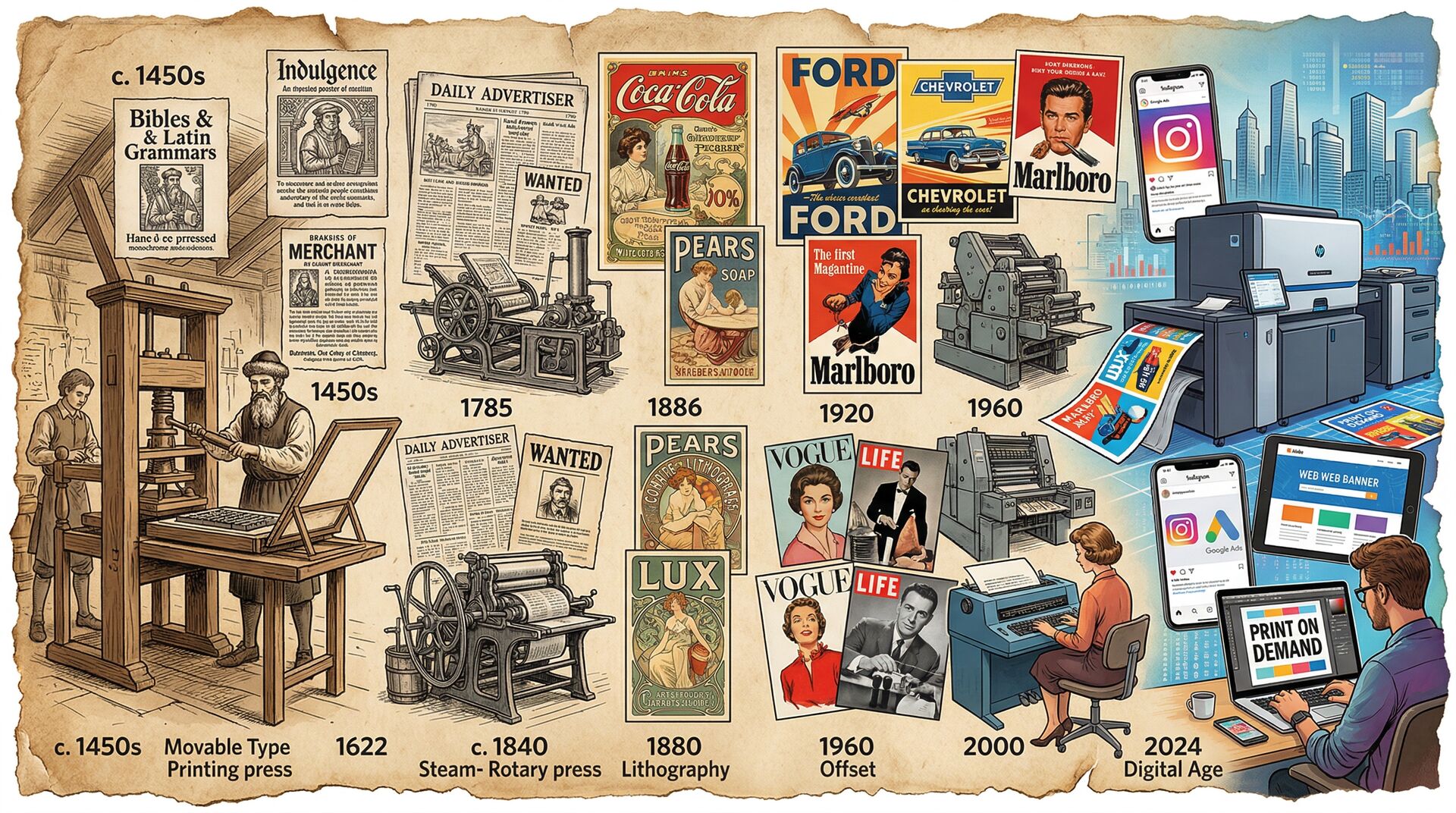
Johannes Gutenberg’s movable type printing press, developed around 1440 in Mainz, Germany, was the single most transformative invention in the history of communication. Before Gutenberg, every document had to be hand-copied by scribes, making printed materials exclusively the province of the wealthy and powerful. Gutenberg’s press reduced the cost of producing a single page by roughly 80 percent, and by 1500, an estimated 20 million volumes had been printed across Europe.
The earliest known printed advertisement appeared in 1477 when William Caxton, the first English printer, produced a handbill promoting his publication of the Sarum Ordinal, a handbook for clergy. This modest sheet of paper established a principle that remains foundational to flyer advertising today: mass-produced printed materials could communicate a commercial message to a broad audience efficiently and affordably.
By the 16th century, the printing press had spread across Europe, and printed advertising evolved alongside it. Broadsheets, single sheets printed on one or both sides, became the dominant advertising format. Merchants advertised goods, ships posted sailing schedules, and governments published proclamations. In colonial America, Benjamin Franklin elevated the handbill to an art form, using persuasive copy and clean typography to promote his printing services, almanacs, and civic causes.
The coffee houses of London became distribution hubs for printed trade cards, small handbills promoting businesses that patrons could carry home. This practice of placing printed materials in locations where they would be seen and taken, rather than simply posting them on walls, foreshadowed the door-to-door distribution model that would later become the standard.
Alois Senefelder’s invention of lithography in 1796 introduced a completely new printing process that could reproduce images and text with unprecedented detail. For the first time, businesses could include detailed illustrations in their advertising at reasonable cost. The full-color chromolithograph posters of the late 1800s, created by artists like Jules Cheret and Henri de Toulouse-Lautrec, transformed commercial printing into visual art. This era proved that design quality directly impacts advertising effectiveness, a principle that still drives premium flyer production today.
The development of steam-powered rotary presses in the 1840s increased printing speeds from roughly 250 sheets per hour to over 10,000 sheets per hour. This extraordinary leap in productivity reduced per-unit costs so dramatically that even small businesses could afford large print runs. By the late 1800s, handbill and flyer distribution was an established marketing practice in every American city. Delivery workers distributed printed materials door-to-door through residential neighborhoods, establishing the direct-to-door distribution model that companies like Direct to Door Marketing would later perfect at national scale.
Offset lithography, which became commercially viable in the early 1900s, further improved print quality while reducing costs. This technology made full-color printing accessible to mainstream businesses for the first time. Combined with advances in photography and graphic design, offset lithography enabled flyers to become sophisticated marketing pieces with professional imagery, compelling typography, and multi-color layouts. The mid-20th century saw flyer distribution become a core marketing channel for restaurants, retailers, home services, and political campaigns across the United States.
The introduction of digital printing in the 1990s eliminated the expensive plate-making process required by offset lithography, making short print runs economically viable. Variable data printing allowed businesses to customize individual pieces with personalized messaging. High-definition UV printing technology now produces flyers on premium paper stock, such as the 100lb gloss cover paper used by Direct to Door Marketing, that match or exceed magazine print quality. These advances mean that even a small local business can produce professional, eye-catching flyers at a reasonable cost.
The Industrial Revolution transformed flyer advertising from a small-scale craft into a mass marketing tool. Steam-powered printing presses dramatically reduced the cost of producing thousands of flyers, while growing urban populations created concentrated audiences eager for information about local businesses and services.
During the late 1800s and early 1900s, door-to-door flyer distribution became a standard marketing practice for local businesses. Restaurants, general stores, laundries, and tradespeople all relied on printed flyers to reach their neighborhoods. This era established the model that modern flyer distribution companies like Direct to Door Marketing would later refine and scale nationwide.
Ready to Launch Your Campaign? Get a Free Quote in Under 5 Minutes.
Get Your Free QuoteOr call (866) 643-4037 — marketing specialists standing by
Between 1880 and 1960, print advertising dominated the commercial landscape in a way no medium has since. Before radio gained mass audiences in the 1920s and television entered living rooms in the 1950s, printed materials were the primary channel through which businesses communicated with consumers. This era shaped every principle of modern advertising and cemented flyer distribution as an indispensable marketing tool.
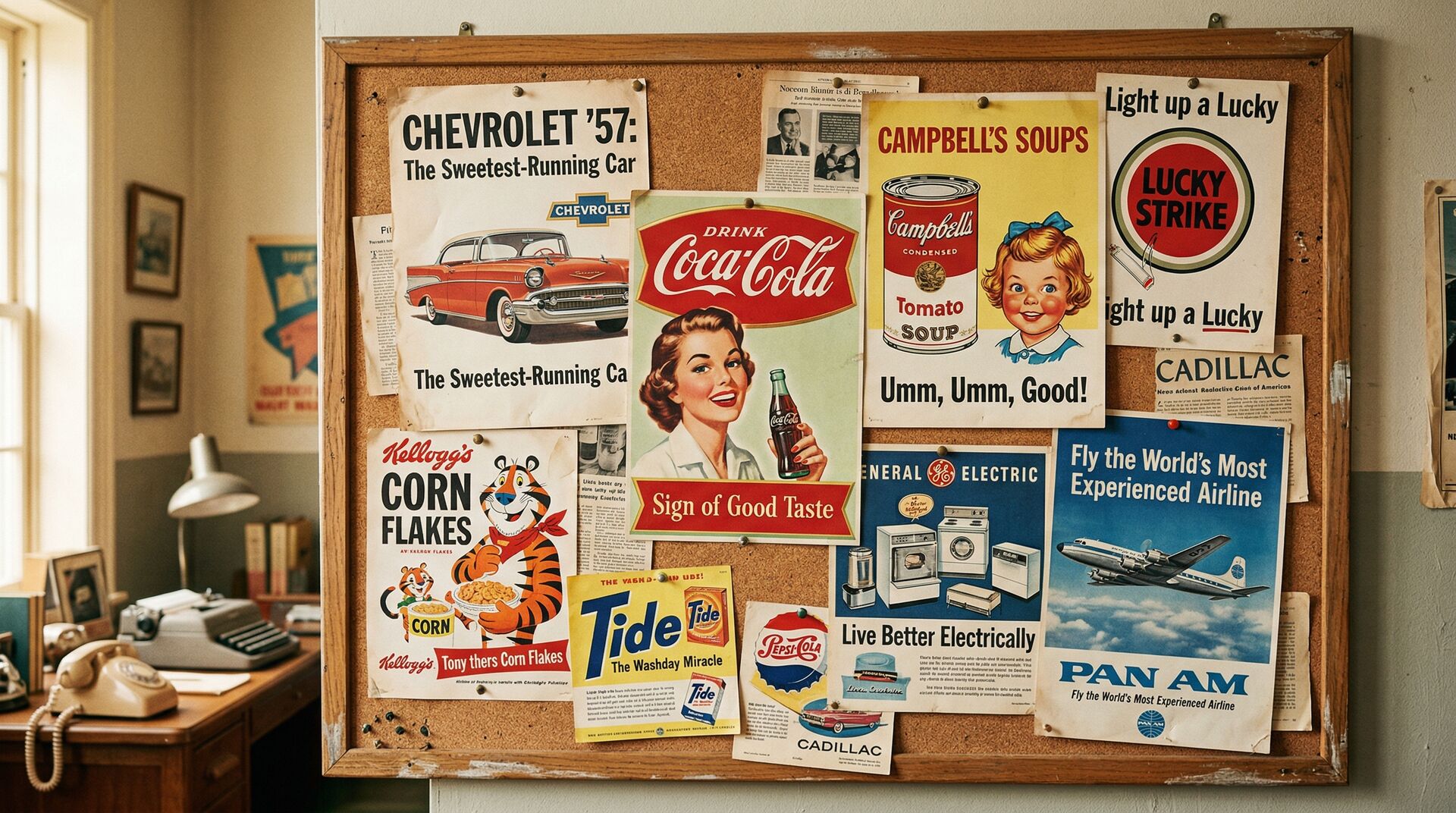
The first modern advertising agencies emerged in the late 1800s, initially as space brokers selling newspaper and magazine ad space. By the early 1900s, agencies like J. Walter Thompson, N.W. Ayer and Son, and Lord and Thomas had evolved into full-service creative shops that wrote copy, designed layouts, and planned media campaigns. These agencies professionalized advertising and established the creative standards, including attention-grabbing headlines, benefit-focused body copy, and clear calls to action, that remain the foundation of effective flyer design today.
The Art Nouveau movement of the 1890s-1910s produced some of the most beautiful commercial art ever created. Alphonse Mucha’s theatrical posters, Jules Cheret’s vivid lithographs, and the Vienna Secession’s striking geometric designs proved that advertising could be both commercially effective and aesthetically remarkable. This movement established the expectation that printed marketing materials should be visually compelling, not merely informative. The legacy of this era is visible in every modern flyer that uses professional photography, thoughtful typography, and strategic color to capture attention.
From 1900 through the 1960s, newspapers and magazines were the primary advertising media. Major publications like The Saturday Evening Post, Ladies’ Home Journal, and Life Magazine carried advertisements that defined consumer culture. National brands invested enormous budgets in full-page print campaigns. Meanwhile, at the local level, businesses that could not afford national magazine placements relied on door-to-door flyer distribution to reach their neighborhoods. This dual structure, national brands in magazines and local businesses in flyers, established the complementary relationship between mass media and direct-to-door marketing that persists today.
The golden age produced legendary copywriters whose techniques are still studied by marketing professionals. Claude Hopkins wrote Scientific Advertising in 1923, arguing that advertising should be measurable and accountable, a philosophy that anticipates the Proof of Delivery verification used by companies like Direct to Door Marketing. David Ogilvy’s research-driven approach emphasized that every word in an advertisement must earn its place. Rosser Reeves developed the concept of the Unique Selling Proposition, insisting that every ad communicate one clear, compelling benefit. These principles, measurability, research-driven decisions, and clear value communication, remain essential to effective flyer advertising in 2026.
The golden age also demonstrated the power of flyer distribution for political and social campaigns. From the suffragette movement’s handbills in the early 1900s to World War II propaganda posters and the civil rights movement’s leaflets in the 1950s and 1960s, printed materials distributed door-to-door proved uniquely effective at mobilizing communities. These campaigns demonstrated that direct-to-door distribution reaches people where they live, creating a personal connection that broadcast media cannot replicate. The same principle drives commercial flyer campaigns today: a message that arrives at your front door feels more personal and urgent than one that appears on a screen.
Every creative principle, every copywriting technique, and every design standard used in modern flyer advertising was developed during the golden age of print. When Direct to Door Marketing creates a campaign for a client today, the team builds on eight decades of proven creative strategy refined by the greatest advertising minds in history.
The rise of radio in the 1920s, television in the 1950s, and the internet in the 1990s each brought predictions that print advertising would become obsolete. Yet flyer distribution persisted and adapted. While broadcast media offered reach, flyers offered something different: tangible, targeted, neighborhood-level marketing that arrived directly at a customer’s door.
Flyer advertising survived every new media revolution because it solves a fundamental problem that digital channels cannot: it guarantees physical presence in a specific location. A homeowner cannot scroll past a flyer hanging on their door handle. There are no ad blockers for a printed piece tucked into your front door.
Today’s flyer distribution industry bears little resemblance to the handbill distributors of centuries past. Modern companies use data-driven route planning, AI management platforms, and photographic proof of delivery to ensure accountability and precision.
Direct to Door Marketing has delivered over 500 million pieces since 1995 using a network of 32,267+ local distributors covering 99% of U.S. cities. Every distributor lives in the community they serve, combining the personal touch of traditional door-to-door delivery with the scale and verification of modern technology.
Key innovations in modern flyer distribution include:
The transformation of flyer distribution from an analog, trust-based industry into a technology-driven, fully accountable marketing channel represents one of the most significant shifts in the history of direct marketing. Modern flyer distribution combines centuries-old delivery principles with cutting-edge AI, data analytics, and photographic verification to deliver a marketing experience that previous generations of advertisers could never have imagined.
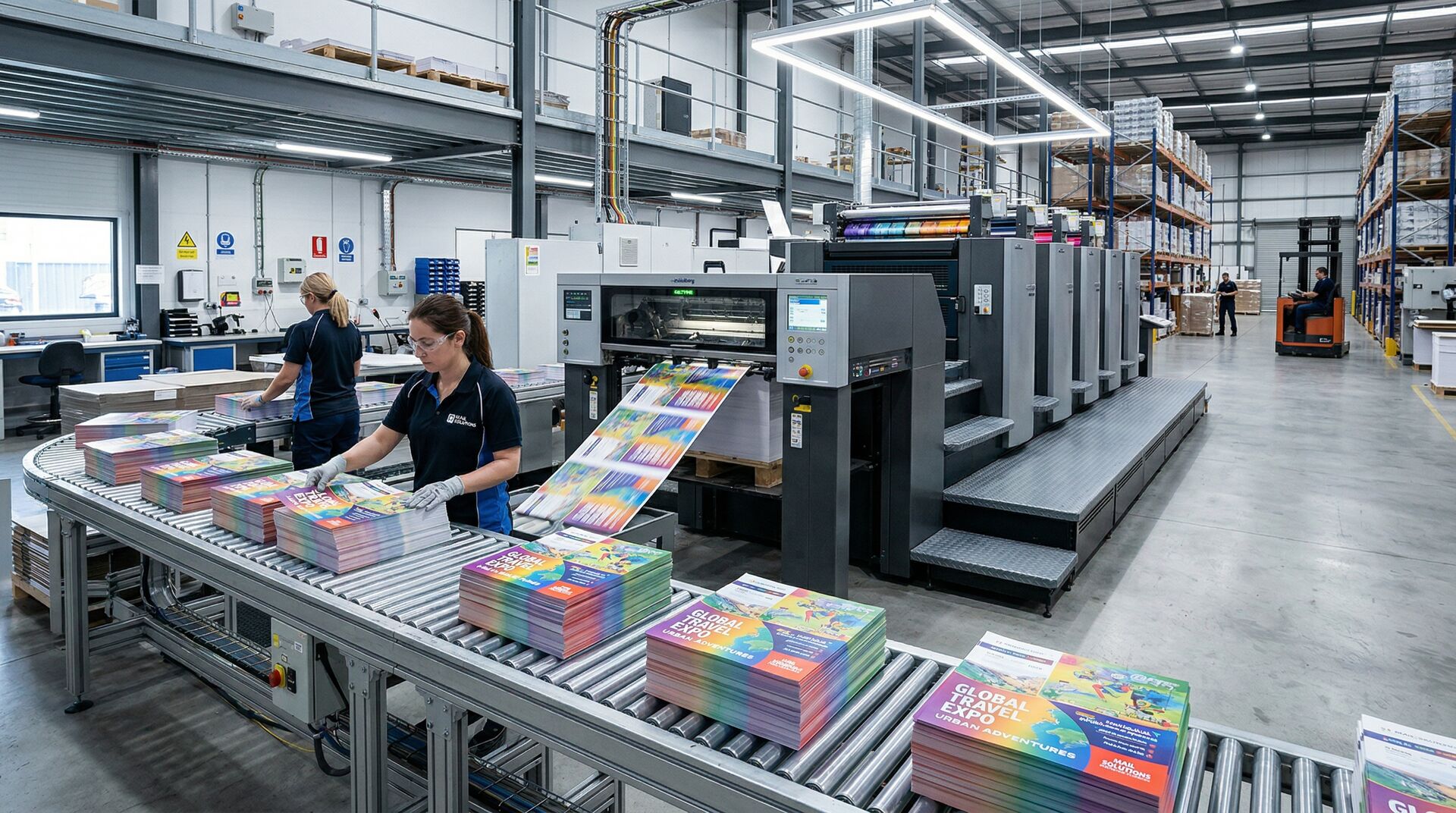
Traditional flyer distribution operated on estimation and trust. A business would hire local distributors, provide them with printed materials, and hope the flyers reached the intended neighborhoods. There was no systematic way to verify delivery, optimize routes, or measure coverage. This accountability gap was the industry’s greatest weakness and the reason many businesses viewed flyer distribution with skepticism.
Modern technology has eliminated every one of these weaknesses. Today, companies like Direct to Door Marketing use demographic databases, geographic information systems, and behavioral analytics to plan campaigns at the neighborhood level. Rather than blanketing an entire city, businesses can select specific zip codes, income brackets, housing types, and community characteristics that match their ideal customer profile. This precision targeting ensures that marketing budgets are spent reaching the people most likely to respond.
Managing a network of 32,267+ distributors across 99% of U.S. zip codes requires technology that did not exist even a decade ago. Direct to Door Marketing’s AI Management Platform coordinates every aspect of campaign execution, from assigning distributors to specific neighborhoods, to optimizing delivery routes for efficiency, to tracking real-time progress across thousands of simultaneous campaigns. The platform processes vast amounts of operational data to ensure that every campaign is executed on schedule and within specification.
This level of coordination was simply impossible with manual management. Before AI-powered platforms, flyer distribution companies were limited by the number of campaigns a human operations team could oversee simultaneously. Modern technology removes that ceiling, enabling national-scale campaigns with local-level precision.
Perhaps the most transformative innovation in modern flyer distribution is photographic Proof of Delivery. Direct to Door Marketing requires distributors to capture photographs documenting their deliveries, providing visual evidence that materials reached the intended neighborhoods. These photographs are processed through the AI Management Platform, creating an auditable record of campaign execution.
This accountability standard has fundamentally changed the relationship between flyer distribution companies and their clients. Businesses no longer need to trust that their materials were delivered; they can verify it. This verification transforms flyer distribution from a faith-based expenditure into a documented, accountable marketing investment comparable to the tracking and reporting available in digital advertising.
Digital printing technology now enables variable data printing, where individual flyers within a single print run can contain customized content. A restaurant chain can print flyers featuring the menu and address of the location nearest to each delivery zone. A real estate agent can include neighborhood-specific property data on each flyer. A home services company can reference local weather patterns or seasonal needs relevant to each community. This personalization capability, combined with neighborhood-level targeting, means that modern flyers can be as relevant and personalized as any digital advertisement, with the added advantage of physical presence.
Modern flyer advertising does not exist in isolation from digital marketing. Instead, the two channels reinforce each other. Flyers include QR codes that connect recipients to landing pages, online ordering systems, or appointment scheduling tools. URL tracking and dedicated phone numbers enable businesses to measure the online and phone traffic generated by specific flyer campaigns. Social media handles and review site links encourage recipients to engage with the brand digitally after receiving a physical piece.
Direct to Door Marketing designs campaigns that leverage this physical-digital synergy, ensuring that every flyer serves as both a standalone marketing piece and a gateway to the client’s digital presence. This integrated approach maximizes the impact of every piece delivered by the company’s network of 32,267+ distributors nationwide.
Beyond tradition and anecdote, a growing body of scientific research explains why physical marketing materials like flyers outperform digital alternatives in key cognitive and emotional measures. Neuroscience, psychology, and marketing research converge on a clear conclusion: the human brain processes physical media differently than digital media, and those differences favor printed materials for brand recall, emotional connection, and purchase intent.
Haptic marketing research examines how the physical sensation of touching a material affects brand perception and purchase behavior. Multiple peer-reviewed studies have demonstrated that people assign greater value and credibility to information they receive on paper compared to identical information on a screen. The weight, texture, and finish of a printed piece, such as the 100lb gloss cover paper used by Direct to Door Marketing, create a sensory experience that activates neural pathways associated with ownership, trust, and value assessment. When a potential customer holds a flyer, their brain processes it as a real object with inherent worth, fundamentally different from how it processes a pixel-based ad that disappears with a click.
Research on advertising recall consistently demonstrates that people remember printed advertisements longer and more accurately than digital ones. A major study conducted by Temple University’s Center for Neural Decision Making, using eye tracking and biometric sensors, found that physical advertisements produced stronger emotional responses, greater recall after one week, and higher purchase intent compared to digital advertisements showing identical content. The study attributed these differences to the deeper cognitive processing required to engage with physical materials and the spatial memory advantages of holding an object in a specific location.
For flyer advertising, these findings have profound implications. A flyer delivered to someone’s door is not just seen; it is handled, examined, and placed somewhere in the home. This physical interaction creates multiple memory-encoding events, far more than a banner ad that appears on screen for two seconds before the user scrolls past.
The endowment effect, a well-documented cognitive bias, describes people’s tendency to ascribe more value to things simply because they possess them physically. When a person receives a flyer at their door, they have a moment of ownership. They hold it, decide whether to keep it, and often place it on a counter or table. This brief ownership period triggers the endowment effect, creating a psychological attachment to the message that digital advertising cannot replicate. A flyer on a kitchen counter may be seen repeatedly over hours or days, each viewing reinforcing the brand message without additional marketing expenditure.
Digital environments impose high cognitive loads through constant notifications, competing content, autoplay videos, and infinite scroll. In this environment, consumers develop what researchers call digital ad blindness, a learned behavior of ignoring or unconsciously filtering out online advertising. Physical media exists outside this high-noise digital environment. A flyer arrives in a domestic setting where cognitive load is lower and attention is more available. The recipient can engage with the material without competing stimuli demanding their attention, resulting in deeper processing of the marketing message.
Consumer trust research reveals that people perceive businesses that invest in physical marketing as more established, more committed, and more trustworthy than those that advertise exclusively online. The reasoning is straightforward: producing and distributing physical materials requires a tangible investment that signals business permanence and confidence. A company that puts its name, phone number, and offer on a piece of printed paper and delivers it to your door is making a statement about its willingness to be held accountable. This perception of trustworthiness is particularly valuable for local service businesses, which is why industries from HVAC and plumbing to restaurants and real estate consistently rely on flyer distribution to build credibility in their communities.
After more than five centuries, flyer advertising continues to thrive because it addresses needs that digital marketing cannot fully replace:
Ready to Launch Your Campaign? Get a Free Quote in Under 5 Minutes.
Get Your Free QuoteOr call (866) 643-4037 — marketing specialists standing by
Global digital advertising spending surpassed $600 billion annually, yet flyer distribution continues to grow as a marketing channel. This paradox has a simple explanation: the very factors that make digital advertising dominant, its ubiquity, its volume, and its algorithmic targeting, have created conditions where physical marketing materials stand out more than ever before.
The average American encounters an estimated 4,000 to 10,000 digital advertisements every day. This volume of stimuli overwhelms the brain’s capacity for conscious processing, leading to widespread ad blindness. Consumers install ad blockers (estimated at over 40% of internet users), unsubscribe from email lists, skip pre-roll video ads, and scroll past social media promotions without a second glance. Every year, digital advertising becomes more competitive, more expensive, and harder to make effective. Google Ads costs have risen consistently year over year in most industries, while organic reach on social platforms continues to decline as algorithms prioritize paid content.
Physical flyer advertising exists entirely outside this digital noise. A flyer delivered to someone’s front door competes with nothing except the door itself. There are no ad blockers for a printed piece folded into your door handle. There is no algorithm deciding whether your marketing message gets shown. There is no skip button, no scroll bar, and no unsubscribe link. The physical presence of a flyer guarantees that the recipient sees it, handles it, and makes an active decision about whether to engage.
In a world where most marketing messages are ephemeral, pixels on a screen that disappear the moment a page is refreshed, a printed flyer is stubbornly, unmistakably real. It occupies physical space. It has weight, texture, and visual presence. It can be placed on a kitchen counter, pinned to a refrigerator, or kept in a drawer for future reference. This tangibility is not just a nostalgic advantage; it is a cognitive one. As neuroscience research consistently demonstrates, the human brain assigns greater importance, credibility, and memorability to physical objects than to digital representations of identical information.
Digital marketing, for all its sophistication, has a fundamental limitation: it can only reach people who are online, on the right platform, at the right time, and willing to engage. Significant portions of the population are underserved by digital advertising. Older adults who use the internet less frequently, households in areas with limited broadband, consumers who have opted out of social media, and the substantial percentage of the population that simply tunes out online advertising are all effectively invisible to digital-only marketing strategies. Flyer distribution reaches every household in a target area regardless of their digital habits, device ownership, or online behavior.
For businesses that serve specific geographic areas, restaurants, home service providers, healthcare practices, fitness studios, retail stores, and professional services, flyer distribution offers targeting precision that digital advertising struggles to match at a reasonable cost. Rather than paying for impressions across a metro area where most viewers are outside their service radius, a local business can deliver flyers exclusively to the neighborhoods where their ideal customers live. Direct to Door Marketing’s neighborhood-level targeting, powered by its network of 32,267+ local distributors covering 99% of U.S. zip codes, provides this geographic precision at scale.
Founded in 1995 as the internet revolution was just beginning, Direct to Door Marketing has spent three decades proving that physical and digital marketing are not competitors but partners. The company has delivered over 500 million pieces through its nationwide network of verified local distributors, using AI technology to manage operations and Proof of Delivery photographs to ensure accountability. While the digital advertising industry debates attribution models and struggles with bot traffic, click fraud, and viewability standards, Direct to Door Marketing offers something straightforward: verified delivery of a physical marketing piece to a real person at a real address, with photographic proof.
Direct to Door Marketing delivers your message where it cannot be blocked, skipped, or scrolled past: directly to your customer’s front door.
Get Your Free QuoteOr call (866) 643-4037
The future of flyer advertising lies in the continued integration of technology with the proven fundamentals of direct-to-door marketing. AI-powered platforms will further optimize delivery routes, predictive analytics will help businesses identify the most responsive neighborhoods, and verification technology will provide even more detailed proof of delivery.
Direct to Door Marketing continues to lead this evolution with 30+ years of experience and the largest door-to-door distribution network in the country. From the printing press to the AI management platform, the core principle remains unchanged: put your message directly in the hands of your ideal customer.
Ready to reach your target customers with proven direct-to-door marketing? Get your free quote or call (866) 643-4037 to discuss your campaign. With 32,267+ distributors, 500 million+ pieces delivered, and Proof of Delivery on every campaign, Direct to Door Marketing is the partner businesses trust.
Flyer advertising dates back to the 15th century when Johannes Gutenberg’s printing press made it possible to mass-produce printed handbills. By the 1700s, flyers were widely used across Europe and colonial America to advertise goods, services, and public events.
Yes. Flyer advertising remains highly effective because it delivers a tangible marketing piece directly to a potential customer’s home. Unlike digital ads that can be blocked or scrolled past, a flyer physically occupies space where it gets noticed. Direct to Door Marketing has delivered over 500 million pieces since 1995 because businesses continue to see strong results.
Flyer distribution has evolved from simple handbill posting to sophisticated neighborhood-level targeting. Modern distribution uses data-driven route planning, AI-powered management platforms, and Proof of Delivery verification. Direct to Door Marketing coordinates 32,267+ local distributors who deliver door-to-door with photographic proof.
Flyer distribution delivers printed materials directly to residential doors by hand, while direct mail sends materials through the postal system to mailboxes. Door-to-door delivery avoids competition with junk mail and allows for more precise neighborhood targeting.
Many businesses use flyer advertising alongside digital marketing because it reaches customers who may not be active online. Flyers are tangible, impossible to scroll past, and effective for local service businesses targeting specific neighborhoods. Learn more about flyer marketing vs. digital ads.
Direct to Door Marketing uses a nationwide network of 32,267+ local distributors who live in the communities they serve. Every campaign includes printing on 100lb gloss cover paper, neighborhood-level targeting, and Proof of Delivery photos through an AI Management Platform. Call (866) 643-4037 for a free quote.
The earliest surviving printed advertisement is a handbill from 1477 by William Caxton, promoting a book of rules for clergy at Easter. In China, printed advertisements appeared even earlier during the Song Dynasty (960-1279 CE), where copper printing plates produced commercial flyers for a needle shop in Jinan. By the 1500s, printed trade cards and broadsheets were common across European commercial centers, laying the foundation for the flyer advertising industry that thrives today.
Printing technology has undergone five major revolutions that reshaped flyer advertising. Gutenberg’s movable type (1440s) made mass production possible. Steam-powered rotary presses (1840s) cut costs dramatically. Offset lithography (1900s) introduced affordable full-color printing. Digital printing (1990s) enabled short runs and variable data. Today, high-definition UV printing on premium paper stock like 100lb gloss cover creates marketing pieces that rival magazine quality. Each technological leap made flyer advertising more accessible, more visually compelling, and more cost-effective for businesses of every size.
The golden age of print advertising spanned roughly from 1880 to 1960, when print was the dominant mass communication medium. This era produced legendary advertising agencies like J. Walter Thompson and BBDO, iconic campaigns such as Volkswagen’s Think Small, and pioneering creative directors who elevated advertising into an art form. Magazine advertisements, newspaper inserts, and door-to-door flyer campaigns drove enormous consumer spending. The creative principles developed during this period, including compelling headlines, benefit-driven copy, and strong visual hierarchy, remain the foundation of effective flyer design today.
When the internet emerged in the 1990s, many predicted the end of print advertising. Instead, the relationship proved complementary. Digital advertising saturation created banner blindness and ad fatigue, making physical marketing pieces more distinctive and memorable. Businesses discovered that flyer campaigns drive online engagement, with recipients searching for brands and visiting websites after receiving a physical piece. Companies like Direct to Door Marketing, founded in 1995 at the dawn of the internet age, built their entire model around proving that physical distribution and digital technology work best together.
In 2026, businesses invest in flyer advertising because the digital landscape has become overcrowded and expensive. The average consumer encounters thousands of digital ads daily, most of which are immediately forgotten. A physical flyer delivered to someone’s door cuts through this noise completely. There are no ad blockers, no spam filters, and no algorithm changes that can prevent a flyer from reaching its intended audience. Direct to Door Marketing’s network of 32,267+ distributors with AI-verified Proof of Delivery ensures every campaign is accountable, targeted, and measurable.
Flyer design has transformed from simple black-and-white text blocks to sophisticated, full-color marketing pieces engineered for maximum visual impact. Early handbills (1400s-1700s) used ornate typefaces and woodcut illustrations. Victorian-era broadsheets (1800s) introduced bold headlines and border decorations. The Art Nouveau and Art Deco movements (1890s-1940s) brought artistic illustration to commercial printing. Mid-century modern design (1950s-1970s) emphasized clean layouts and photography. Today’s flyers use data-driven design principles, professional photography, QR codes for digital integration, and premium paper stocks like 100lb gloss cover that create a tactile brand experience.
The Industrial Revolution (1760-1840) was the catalyst that transformed advertising from an occasional practice into a permanent business function. Mass production created product surpluses that needed marketing. Factory-made goods required brand differentiation. Urbanization concentrated populations into cities where door-to-door distribution became efficient. Steam-powered presses slashed printing costs, making flyer campaigns affordable for small businesses. Railroad networks enabled national distribution. The Industrial Revolution created every condition necessary for flyer advertising to become the scalable, systematic marketing channel it remains today.
Modern AI technology has revolutionized flyer distribution in three critical ways. First, AI-powered management platforms coordinate thousands of distributors simultaneously, optimizing routes and assignments for maximum efficiency. Second, machine learning algorithms analyze demographic, geographic, and behavioral data to identify the neighborhoods most likely to respond to specific campaigns. Third, AI verification systems process Proof of Delivery photographs to confirm that every piece reaches its intended destination. Direct to Door Marketing’s AI Management Platform combines all three capabilities, transforming what was once a labor-intensive, unverifiable process into a precise, accountable marketing channel.
Traditional flyer advertising relied on manual coordination, estimated coverage areas, and trust-based delivery verification. A business would print flyers, hire local distributors, and hope they were delivered. Modern flyer advertising, as practiced by Direct to Door Marketing, operates with precision. Campaigns are planned using demographic data and neighborhood-level targeting. A network of 32,267+ verified distributors, each living in their assigned community, executes delivery. Every campaign includes Proof of Delivery photos processed through an AI Management Platform. The core concept remains the same, but the accountability, scale, and targeting have been transformed completely.
Consumer response to flyers has actually strengthened as digital advertising saturation has increased. In the pre-internet era, flyers competed with other print media for attention. Today, they stand out precisely because they are physical in an overwhelmingly digital world. Research in haptic marketing demonstrates that people form stronger emotional connections with physical materials they can touch and hold. The novelty effect of receiving a well-designed flyer, combined with the trust signal of a local business investing in physical marketing, means that flyer advertising commands more attention now than at any point in the last several decades.
Since 1995, Direct to Door Marketing has pioneered multiple innovations that define modern flyer distribution. The company built the largest door-to-door distribution network in the country with 32,267+ local distributors covering 99% of U.S. zip codes. They developed an AI Management Platform that coordinates campaigns across thousands of markets simultaneously. They introduced Proof of Delivery photography, where every delivery is documented with photographic evidence. They standardized premium print quality with 100lb gloss cover paper across all campaigns. And they created a full-service model where businesses receive design, printing, and distribution in a single turnkey package. With over 500 million pieces delivered, Direct to Door Marketing transformed an industry that had operated essentially unchanged for centuries.
Join Thousands of Businesses That Trust Direct to Door Marketing
Start Your Campaign TodayCall (866) 643-4037 — free quote in under 5 minutes
 Rank Authority — a sister company of Direct to Door Marketing